Introduction. What We Missed? What We Lost? What We Forgot?
AAlina Șerban
As currently drafted, the feverish sound of freedom that swept over the socialist world at the end of 1989, reclaiming de jure the public sphere, is—for the youngest—a far too distant memory. That deafening sound, which reverberated for a long time throughout the 1990s, in various tones, in the streets and in people’s minds, infused the post-communist society of those years with a sense of collective commitment, and hope of a better life. Everything seemed possible because any gesture denounced the errors of the previous social decade, any public event reflected the intensity and verity of the emotions experienced at community level, and because any promise seemed plausible in the eyes of the fragile and overwhelming post-communist reality.
Many of those who grew up and aged during those years hoped candidly and, likely, stubbornly, that the domino effect that had, out of nowhere, bashed Eastern Europe would bring humanity back to its senses, would relieve it of the cumbersome and cunning baggage of past conventions, and would expose it once more to free will. To choose was certainly the most difficult exercise that the countries of the former Eastern Bloc had to learn how to practise again in the 1990s, and the consequences of the decisions taken collectively in those years are still being felt today, in this very moment in which we live with ease or with concern, in silence or in deep disagreement.
The Eastern European societies’ rationale to make a (more or less inspired) choice was the reaction to the evil that had circulated in varying degrees of manifestation and materialisation after the Second World War, but also to the economic and social collapse in which they found themselves in the early 1990s. From the outside, the transfiguration was quickly imaginable; from the inside, the long process of reform known as transition brought to the surface forgotten flaws, repressed desires and unsuspected forms of radicalisation. The optimistic expectations of the early years were inevitably deferred until later, and in many cases the initial enthusiasm was lost only to be swallowed up by the desolate landscape of ethnic conflicts, the smouldering aggression of nationalism, institutional corruption, and the ferociousness of the market economy. The way out of the phantasm of dialectical materialism meant entering (unexpectedly) the terrain of liberalism. And it was not easy at all! Paradoxically, freedom came with a series of constraints and responsibilities that irreparably affected the collective body and limited individual options. Thus, the rationality of communism was clumsily replaced by the pragmatism of capitalism and, as at any other crucial moment in history, the individual, the human being in its singularity was the first to be abandoned, this time not to follow the cause of whatever ideology but the logic of profit.
At this moment of our contemporaneity, it is perhaps worth revisiting this decade of euphoria and confusion, of contradictory feelings, of vitality and extraordinary collective mobilisation, because to talk about how social, cultural and political ideas and practices were articulated back-then means to search for the lineage of public attitudes and institutional structural mechanisms that are still active today. It is no accident that the current dossier What We Missed? What We Lost? What We Forgot? provides an overview of the period from the perspective of the position adopted by the artist and the cultural sphere in general in order to put forward critical opinions and signal the unsettling slippages of post-communist governments, helping to strengthen the role of civil society.
Beyond the heterogeneous historical itineraries on which countries such as Serbia, Romania or Hungary have embarked, the epistemic mutations that have occurred in the public sphere emphasise, in each of these contexts, the need to imagine other spaces and other means of social dialogue, art assuming here a participative role: being the place from where one can negotiate and confront the public tensions and prospects. The artist, alongside and together with the new institutionally self-organised platforms, act in the spirit of solidarity striving for a society in which to live better. The topics tackled and exposed within the independent local artistic milieus tend to mirror phenomena provoked by the discontinuities and ruptures appearing in the social and political fabric, and to denounce the exoticism imprinted to the region with consequences in accommodating Eastern European art to the global art system. At the same time, the excessive polarisation of everyday realities and the new behavioural rules introduced as a consequence of the free market familiarisation are discussed in the cultural and artistic context of the time, analysing the accelerating tendencies to de– and re-politicise the public space due to, among other reasons, the increased flow of messages transmitted via press and television.
The symbolic threshold represented by the 1990s and the specific way in which the artist and art institutions resonated with the real conditions of collective life are discussed by the contributions included in this dossier, signed by art and architectural historians, philosophers and curators attached through their own research, exhibition and editorial projects to this topic. The articles complement and expand the themes opened up by the Performing 89. States of Disillusion exhibition, a comparative reading of the performative and analytical approaches present in the art of the 1990s in Serbia, Romania and Hungary.
Alina Șerban is art historian, curator and writer, cofounder of the Institute of the Present, Bucharest and founder of the publishing programme P+4 Publications. Her research focuses on topics dealing with the history of the exhibitions, the non-linear historiographies of post-war Eastern European art and its specific theoretical and social contexts of manifestations, oral histories and artistic archives. She was Grant recipient of Igor Zabel Award for Culture & Theory, Ljubljana (2022). Her recent projects include: the exhibition Performing 89. States of Disillusion (2023) and the monograph Constantin Flondor. When Eye Touches Cloud (2021).
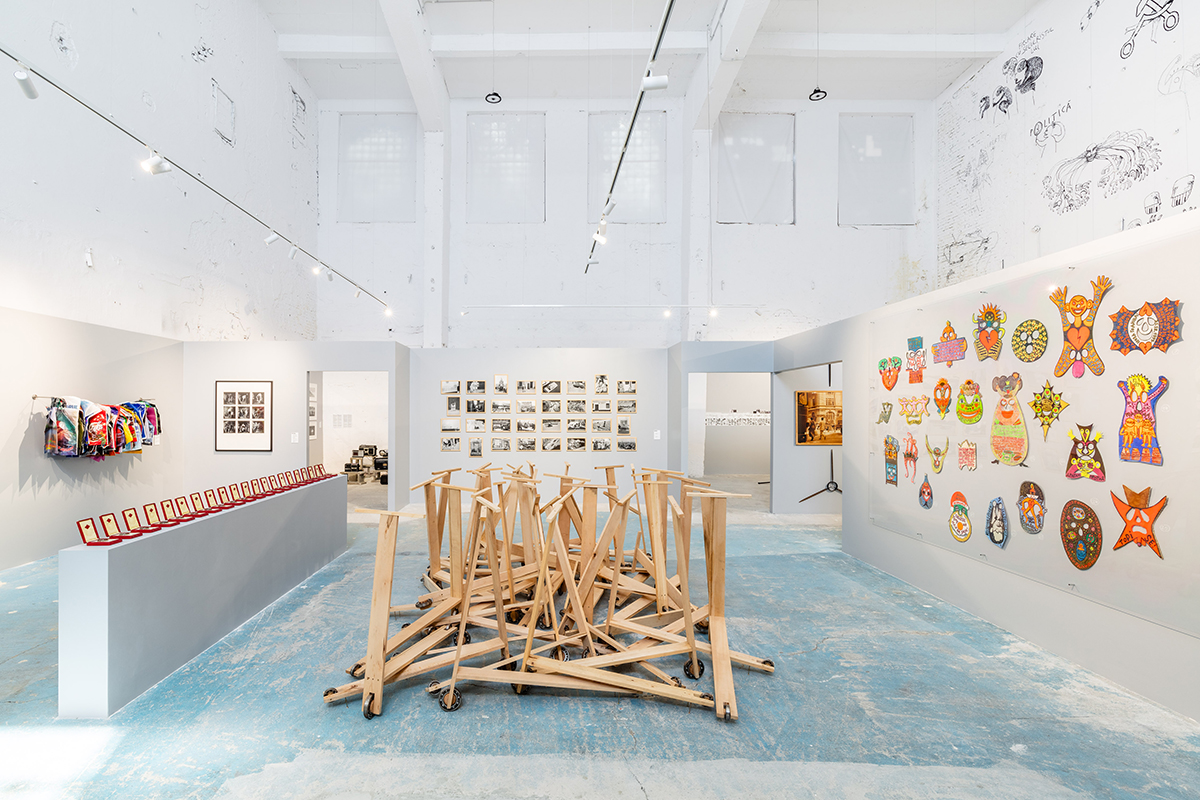
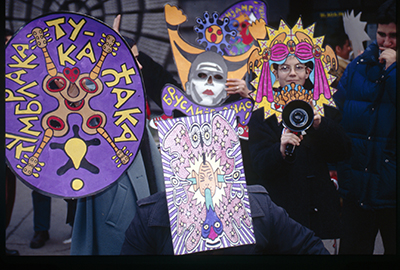
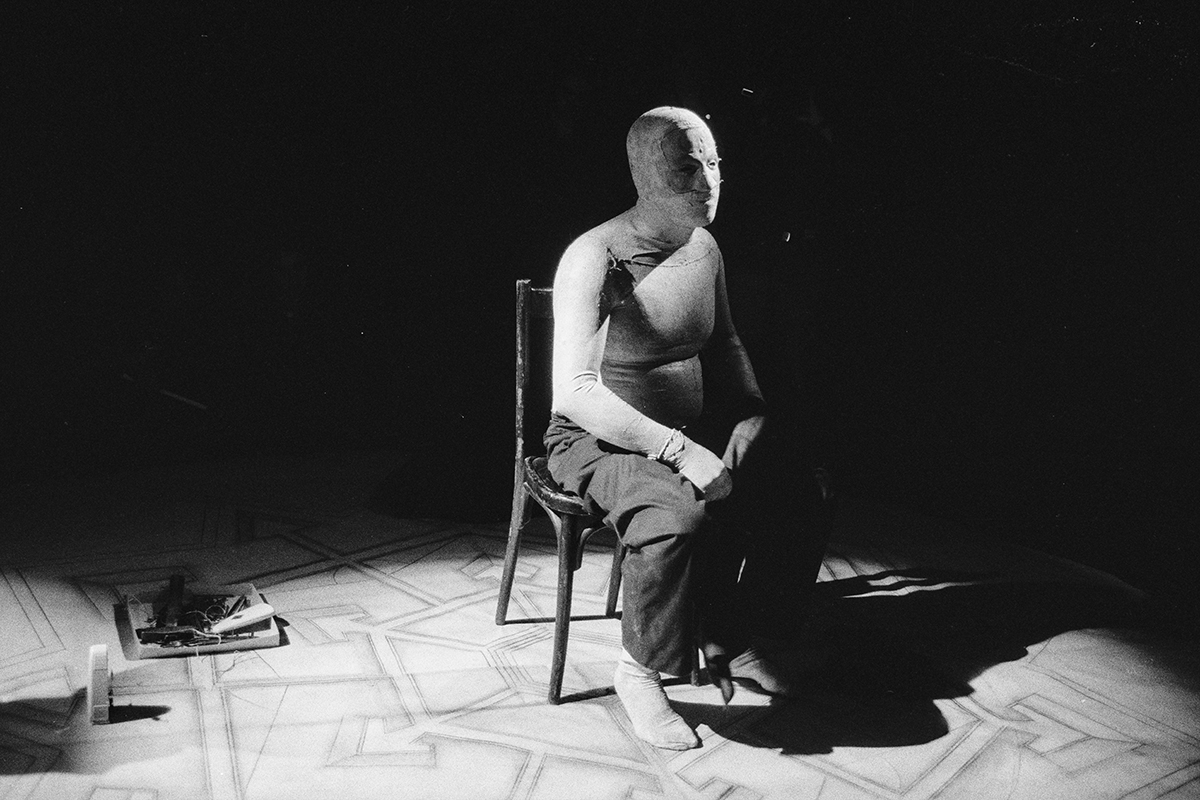
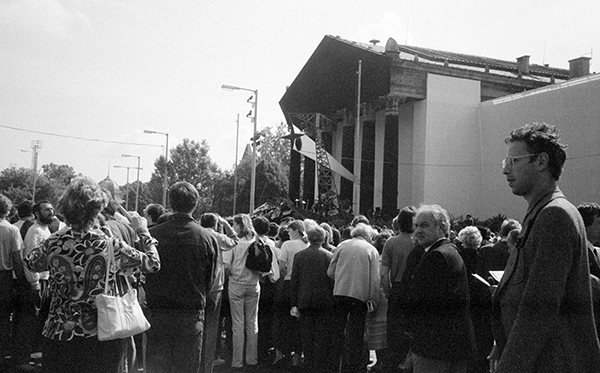
“Performing 89. States of Disillusion”, exhibition view (Faber, Timișoara, 7.9–22.10.2023). Photograph by Serioja Bocsok. Courtesy of The Institute of the Present
Redirections of Performativity in Art of the 1990s in Serbia. On “Dissensus” in the Works of Škart, Zoran Todorović and Milica Tomić
BBranislav Dimitrijević
During the 1990s the notion of performativity in art gradually swayed away from its canonical form in which performance art was primarily associated with body-art, acts performed by artists using their own bodies as materials and conduits of expression and meaning. When speaking from the context of the history of performance art “behind the Iron Curtain,” the performing artistic body was most commonly associated with an act of dissent against the disciplining of the subject under what is called “communist dictatorship”—the body was both the location of social projection and the site of liberation from these projections. In its radical expression, performance art involved forms of transgressive behaviour among which the suffering and endangering of artist’s body was often seen as an agonising and antagonising reaction to the lack of personal freedom and the possibility of evading ideological prohibitions by transferring the emphasis from an impenetrable social political sphere to a personal political sphere. With the fall of the Berlin Wall, this practice became a significant marker in the dominating interpretations of “communist totalitarianism” and of dissident voices and bodies unmasking and challenging that system. In performance art the body of an artist was often associated with political dissidence, with embodying the anxieties and suffering under the political system that brought the body of an artist in peril, and re-directing the act of transgression towards the Real of one’s own body and its limits.[1]
The art of the 1990s did express a growing interest in the 1970s conceptualist practice, with performance being one of its signature aspects. As the pioneering historicisation of performance art in Eastern Europe shows,[2] the focus was exclusively on the performing bodies of artists themselves. Although the exhibition included some cases of body-art from the 1990s, these examples indicate that although there was a need to reconnect with the radical legacy of new artistic practice, there was also a question if the focus on the performativity of the body of the artist remained as relevant for contemporary art within the changed social and economic environment after 1989. Whilst the history of performance art within the scope that the leading Yugoslav modernist art critic Ješa Denegri named “artist in the first person”[3] was indeed canonised, and its protagonists reached their historical acclaim, the emerging artists ventured to re-think and re-define this legacy that led to questioning the fetish of their performing figure.
The image of an artist standing in a gallery space in front of an audience and performing something with his/her body or to his/her body, seemed less present in the Serbian art context of the 1990s. One of the reasons is most definitely the institutional collapse,[4] but more importantly it was a critical awareness that a self-expressive performative gesture reached an impasse. When in a retrospective one takes a look back to probably the best-known artistic performance of such kind in Serbia of the 1990s, Personal Space (1996) by Tanja Ostojić, this performance as if sums up the symbolic endgame of the “artists in the first person” type of body-art in a changed situation. The naked body of the artist, meticulously shaved and entirely covered by white marble powder (so it takes the shape of some classical sculpture) stood motionless for hours.[5] This remarkable “zero-point” of performance (emphasised by Malevich’s “white square on white” formed by marble powder on the floor where she was standing at) as if pressed the stop button for some years on this particular language of body-art, and Ostojić herself departed in different direction with her collaborative, feminist and relational works like Looking for a Husband with EU Passport (2000–2005).
As opposed to the individual presence/action of the body as projected upon and as channelling and expressing this projection, there was the emerging tendency to consider a body in art as a body-in-common, body-in-collectivity, always and only in relation to other bodies. Mainly because of its commodification (the full denial of its emancipatory promise) the enduring solitary body of an artist could no longer represent or construct a dissensus. Although this pivotal term in Rancière’s philosophy was not used at the time, it came later to denote what was essential in this turn in artistic relation to the performative. If le dissensus is about “confronting the established framework of perception, thought and action with the inadmissible political subject,” then the figure of the performance artist set to have that role in the “communist” social setting could no longer be a political subject that “resists juridical litigation and creates a fissure in the sensible order.”[6] The performative in art shifted towards a different proposition of dissensual, and that redirection broadened the scope of performativity. Falling outside the scope of western critical theorists who introduced the main operative terms, such are “relational aesthetics,” “participatory art,” or the art of the “social turn,”[7] it is interesting that in peripheral, and almost fully isolated artistic environment such was the Serbian in the 1990s,[8] this paradigmatic turn was very early manifested by some specific, localised and situated propositions. In this text I will reflect upon this changing mode of artistic performativity in the examples of the works by the group Škart, Zoran Todorović and Milica Tomić.[9]
The political situation in Serbia after 1989 was an event of mass body politics. And not only in terms of how Slobodan Milošević organised masses to rally in his support to create one of the first post-1989 regimes that are now branded “illiberal democracies,” but in a capillary takeover of the public space and the media space with a cultural and intellectual agenda that produced either more or less voiced mass compliance or more or less performed individual exclusion. It was no longer about that there is a system which is restrictive, but rather that there is a system which is overly permissive—a condition in which everything seemed allowed.[10] The war in Yugoslavia of the 1990s, all the crimes committed, in an Adornian sense, made it impossible for any serious artist to treat her or his body as an object of suffering. The reality of suffering in the war was too strong of a signifier, so it created a changed public sphere that affected the entire “social body.”
And it was this social body that got cracked and was practically sacrificed for a new political reality. At that time, it seemed that the collective body was primarily redirected from its purpose in socialist rituals to its ideological exploitation in nationalist mass politics. However, as we know now, and as it was sensed already for example in the work of the Group Škart in the early 1990s, the collective body was fragmented by desires and realities of another process that apart from rampant nationalism affected the public sphere: the process of privatisation of public (social) property. However, if we don’t treat the war only as a savage outburst of violent nationalism, or even simply as a Serbian aggression on neighbouring republics, we could agree with an argument that the Yugoslav war of the 1990s was in fact also a mode of another process: a violent form of privatisation.[11] The privatisation is a violent affair as such: “it is a violent dismemberment and private appropriation of the dead body of the socialist state, both of which recall sacred feasts of the past in which members of a tribe would consume a totem animal together,” as Boris Groys summed it up.[12] Privatisation was not only a socio-economic process but also as a way of thinking: it was happening in the hearts and the minds of citizens. Socialist production based on the model of self-managed factories lost their historical context, and got gradually dismembered and practically eviscerated.
Socialist Yugoslavia was unique for this concept of social property as “property without a titular,”[13] and this concept did instigate some emancipatory effects in the socialist public sphere that during the 1990s and later, got practically rejected, škart-ed.[14] Main aspect of the redirected performativity in the work of Škart[15] was not simply to critically represent the conditions of the public sphere, but to induce situations in everyday life that are both poetic and practical, both modest and directly engaged. The list of Škart’s activities is long,[16] and apart from writing, designing, and printing books, notebooks, posters, flyers, and other paper and cardboard products; they initiated street actions and broadcasted experimental radio programs that all set up conflicting and dissensual situations positioned between the public and the private spheres. Their activities were situated and site-specific, with performativity developed and deployed within specificities of the local context and its discomfortable sense of reality. Performativity as induced in the public space, in a random structuring of ad-hoc communities, in surprising modes of social interaction, confirms in their work that when we talk about performance art “it is not (and never was) a medium, not something that an artwork can be but rather a set of questions and concerns about how art relates to people and the wider social world.”[17]
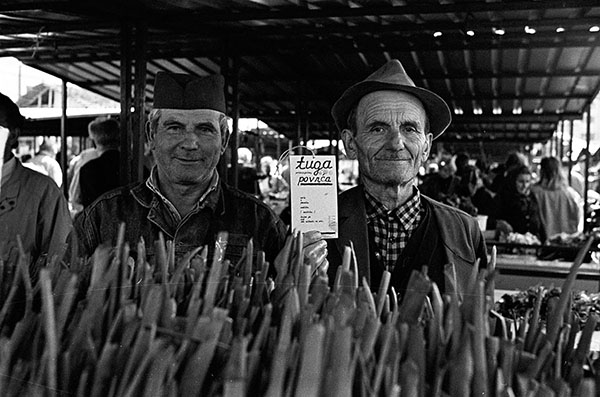
In January 1993, Škart set about realising their signature early work, The Sadness Project. It consisted of short poems dealing with different kinds and classifications of sadnesses, that were printed on thick, hand-sized pieces of cardboard. These cards were publicly distributed to certain “target groups,” each identified with a particular sadness. The initial action took place in front of a major department store in Belgrade where pieces of cardboard bearing the words “The Sadness of Potential Consumers” were handed out. During the following week, the distribution of “The Sadness of Potential Travellers” was organised at the railway station. The “Sadness of Potential Vegetables” was handed out at the green market and “The Sadness of Potential Pan” to children in a park. “The Sadness of Potential Return” was mailed out to friends who had emigrated. “The Sadness of Potential Rifles” was put in packages with humanitarian aid and sent to Bosnia, whilst “The Sadness of Potential Childbirth” was distributed on the streets by a pregnant friend.
Škart, “Sadness of Potential Travellers,” 1993, poetry-distribution-action at the railway station, Belgrade. Photograph by Vesna Pavlović. Courtesy of the artists
Škart, “Sadness of Potential Vegetables,” 1993, poetry-distribution-action at the Kalenić green market, Belgrade. Photograph by Vesna Pavlović. Courtesy of the artists
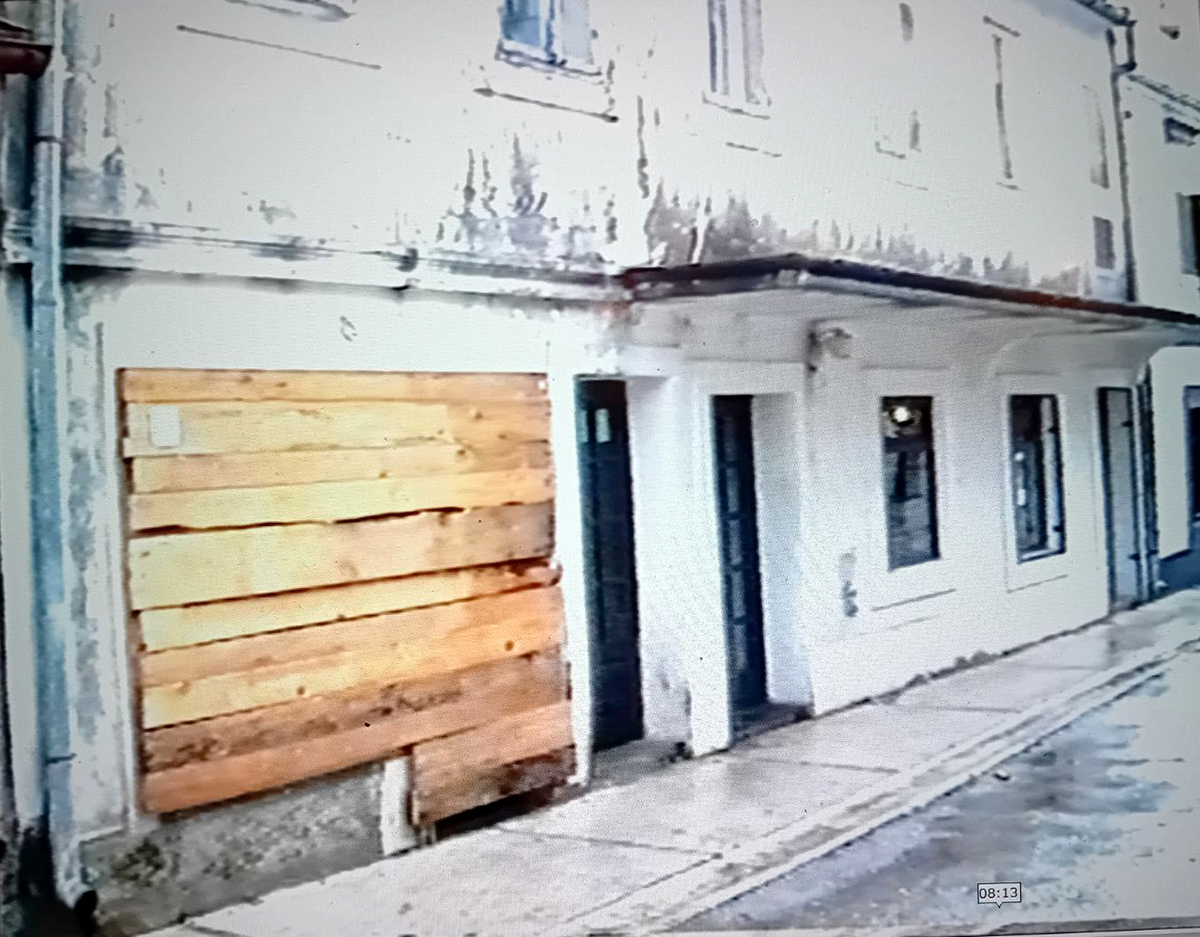
If Sadnesses left a mark on the Belgrade art scene as a pioneering work of its kind, their two public interventions at the Cetinje Biennial[18] 1994 and 1996 belong to the body of the forgotten and lost, given that practically no documentation exists on these works—works that practically came ahead of their times. Both works were dissensual performative gestures, gestures of an antagonising reconfiguration of experience. Both works counter the assumption that “community art” can only be measured by its ethical or socially constructive aims—as the activity of Škart is most often perceived. These works are operating by provoking and subverting the normality of the everyday in a community—this normality implying a wishful construct of a harmonious society without antagonisms, as a post-ideological and post-political “dreamworld.”[19] The work from 1994 consisted of two regularly looking yellow mail boxes mounted on two adjacent walls of a residential building. The opening for inserting letters on one of the boxes was stuck, whereas on the other box they removed the bottom so the inserted letters would instantly drop out. Two years later they returned to the same art event, invited to assemble a shop for their printed work. Instead of opening the shop in the premises they were given, they closed it down, boarded up the door and the windows, and behind the panels they played an audio tape with an endless and “contagious” laughter of a company of people having good fun. This laughter so much irritated the inhabitants of a small town, so on the second night someone tore away the boards and slashed the speakers. The laughter was here located at the breaking point between the consensual and the dissensual. The usually unaffected and dormant coherence of the local community was here provoked by an inadmissible intervention in its paranoiac space. According to Freud, in paranoia the internal perceptions are replaced by external perceptions.[20] In this case the laughter is an external perception of the intruder not just laughing but perceived as laughing at, and thus replacing the disavowed internal self-perception of a community.
Škart, “Untitled,” 1996, still from the video documentation of the site-specific sound installation, 3rd Cetinje Biennial. Audio by Boris Mladenović. Courtesy of the artists
These two works signify a critical reflection in which participatory forms of art came to a crossroad in which their “ethical turn” expressed a consensuality rather than dissensuality, a “positive operation of art” towards an illusion of “restoring lost meaning to a common world” or “repairing the cracks of social bonds.” With these words Rancière criticises the self-congratulatory aim of relational art to “create community situations that foster the development of new forms of social bond.”[21] The ethical turn in participatory art has become the main object of criticism in the writings of Claire Bishop who confronted the habits of evaluating a relationist/performative works of art through their “achievement in making a social dialogue” and by ethical judgments of artistic working procedures and their “value-finding”. Bishop argues for the opposite, for a work of art that is having an impact of “unease, discomfort, frustration, fear, contradiction, exhilaration and absurdity.”[22] With these words the two interventions of Škart in Cetinje could be described, but also the following example: the performative action and subsequent video installation by Zoran Todorović entitled Noise (1998–1999).
Zoran Todorović, “Noise,” 1998–1999, stills from the three-channel video. Courtesy of the artist
This work consists of three comparable events of performativity triggered by an automatic camera installed in three different locations in Serbia: in the public square in Belgrade, in a prison, and in a mental health hospital. The recording could be activated by anyone who stood in front of the camera and who was invited by a written note to utter a statement, or perform any other activity. The two latter recordings were subsequently heavily edited by the authorities of the prison and the hospital (which was the precondition for allowing the artist to install it in their premises) which gave a certain impression that the more transgressive behaviour was to be found among the “free” citizens—however what was recorded was a series of personal testimonies, cries for help, aggressive gestures, spitting at the camera, poetry-reciting, singing, telling jokes, or even the entire performative acts, including one “contributor” flashing out his gun. The camera was a hybrid of a security camera and a street instant photography apparatus. This work engaged participation in a collective (self-)expression as a mixture of agony and social discrepancy, absurdity and denial. The intention of giving voice, of channelling this voice in its antagonistic form has been raised here. As Todorović wrote in his initial statement:
“This work seeks to explore in what measure and in what way different social positions influence the production of context from which a person speaks. Thus it is made of three consecutive images, street scenes, the scenes from a mental clinic and prison. Obviously, the social map is more complex than that and the number of possible positions could increase indefinitely. However, in each story told or face taped we are able to recognise a recording of a broader social landscape from which the face originates. These three positions are therefore taken as the borderline situations or the points of orientation in which the entire social field can be marked off. At the same time, this film does not pretend to represent the speech of different social groups because it would find itself in the very position it is criticising, but is trying to let out a murmur in the system of social representation by offering each voice, including the lowest one, the opportunity to be heard.”[23]
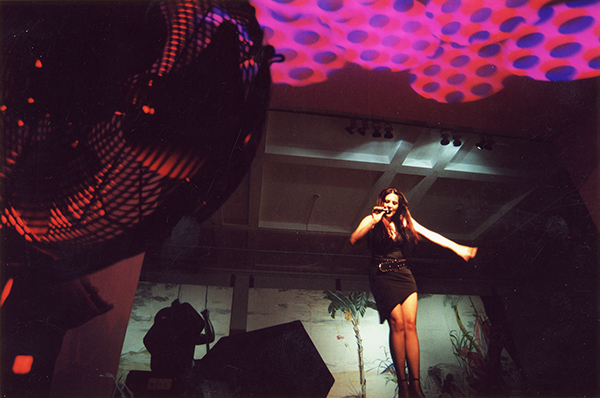
Finally, the last example of the redirection of artistic performativity from the one located in the body of an artist to the one located in a community, takes a notion of a community as a formation that is preordained and already produced by some cultural identity. Whereas Škart’s and Todorović’s work were not strictly speaking performances, the event called I kad jednom pukne ovo srce moje, videćeš u njemu samo ime svoje[24] (later known as This Is Contemporary Art, 2001) organised by the artist Milica Tomić, was a performance, or to use the term coined by Bishop, a “delegated performance.”[25] In collaboration with one of the most popular singers and performers of the so called “turbo-folk” music,[26] Dragana Mirković, Tomić re-stages a regular act of the singer, performed in her concerts, to an art venue, the “house of the artists,” the Vienna Künstlerhaus. Vienna is the city with a largest number of ex-Yugoslav immigrants and the type of music that Mirković performs plays a role of the binding factor among the working classes in expatriate communities—whilst in the bourgeois and intellectual circles this music has been mostly despised, or at least treated in a patronising way. The only utterance of the singer which was not part of her regular performance was the opening line she decided to add: “Good evening, ladies and gentlemen. This is contemporary art!”. Yet, the whole intervention was not so much an act of bringing an unlikely, or even an unacceptable form of performance within the high-cultural perimeters designated for contemporary art, but in performing a direct encounter of communities and their opposing cultural identities and class positions. The main hall of Künstlerhauswas packed and the performance attracted a lively and emotional response, e.g. a cleaning lady working at Künstlerhaus was in tears that something like that can happen in a place she has been working for years.[27]
Milica Tomić (featuring Dragana Mirković), “This Is Contemporary Art” [“I kad jednom pukne ovo srce moje, videces u njemu samo ime svoje”] 2001, performance during Wiener Festwochen, Künstlerhaus, Vienna. Courtesy of the artist
But again, to get to this positive, almost cathartic feeling in a community (as is ironically the goal of most community-art), the artist needed to deal with a series of problematic deliberations. On the one side the questions of cultural racism, of the reification of the invited performer, of the manipulation tactics in relation both to the institution and to the performer and her audience; and on the other side the accusations of promoting disputable values associated with turbo-folk music, of getting involved into its marketing strategies, even aligning with political populism. These and many other raised questions and discussions are practically incorporated in this work that emerged as an event of dissensus. “The specificity of art consists in bringing about a reframing of material and symbolic space. And it is in this way that art bears upon politics.”[28] This and the other works discussed here show how wide are the spectres and possibilities employed in these pioneering examples—materialised in a particular, localised and politicised public sphere that they share in common. And when speaking about the 1990s in Europe, the context of production of these works strikingly differed from the one provided to western artists who at the time got into this particular language of art, art of/as dissensual social performativity.
Branislav Dimitrijević is professor of History and Theory of Art at the College of Art and Design (VŠLPU) in Belgrade. He is a specialist in art and film in socialist Yugoslavia and also regularly writes on relations of contemporary artistic practices and socio-political issues. He has been active as a curator and his projects include large contemporary art exhibitions including Good Life (Belgrade, 2012), No Network (Konjic Nuclear Bunker, 2011), FAQ Serbia (New York, 2010), etc. His books include: Dušan Makavejev’s Sweet Movie (2017), Consumed Socialism: Culture, Consumerism and Social Imagination in Yugoslavia, 1950–1974 (2016) and Against Art: Goran Djordjević, 1979–1985 (2014).
[1] For a discussion on the changes in the performativity of the body in Eastern European art after 1989, see: Branislava Anđelković and Branislav Dimitrijević, “The Body, Ideology, Masculinity and Some Blind Spots in Post-Communism,” in After the Wall. Art and Culture in Post-Communist Europe, ed. Bojana Pejić (Stockholm: Moderna Museet, 1999), 67–73. Reprinted in: Ana Janevski and Roxana Marcoci, eds., Art and Theory of Post-1989 Central and Eastern Europe: A Critical Anthology (New York: Museum of Modern Art, 2018), 315–324.
[2] The exhibition Body and the East curated by Zdenka Badovinac at the Museum of Modern Art in Ljubljana, 1998.
[3] “Artist in the first person” is one of the main operative terms that Denegri used to define the aspect of “new artistic practice” in Yugoslavia of the late 1960s and the 1970s. The term denotes the “artist’s presence in extremely individualistic and subjective expressions who according to his decisions in life and his political (anarchic, extremist, radical) options is irreconcilably opposed to both the art system in which the demands of the market prevail and as well as against the entire social system in which the demands of the dominant ideologies prevail”. See: Jelena Vesić and Branislav Dimitrijević, Yugoslav Artistic Space: Ješa Denegri in the First Person (Zürich: JRP, 2024).
[4] The institutions for culture, especially those for radical practices (like Student Cultural Centre in Belgrade), either deteriorated or hibernated. Only some independent organisations (Cinema Rex, Centre for Cultural Decontamination, Centre for Contemporary Art) supported radical or alternative art practices including performance art. Some artists who began in the 1970s carried out some performances there, for instance Era Milivojević whose ongoing fusion of everyday life and performance did not stop until his death in 2021.
[5] See: Branislav Dimitrijević, “Pain on Both Sides. Tanja Ostojić, personal space,” in Manifesta 2. European Biennial for Contemporary Art (Luxembourg: Casino Luxembourg—Forum d’art contemporain, 1998), 116–117.
[6] Jacques Rancière, The Politics of Aesthetics (London: Continuum, 2004), 85.
[7] These and other terms introduced since the late 1990s in critical art theory in the West need to be adopted for practical and communicative reasons. But one must note that even in seminal critical accounts like Claire Bishop’s, the “social turn” in art is almost exclusively seen as a western phenomenon, with no examples mentioned outside the logic of the western institutions of art, as a “luxury game” of these institutions. Bishop allows herself even to make a highly dubious remark that: “It is telling that body art takes place primarily in the West”. Claire Bishop, Artificial Hells: Participatory Art and the Politics of Spectatorship (London: Verso, 2012), 229.
[8] The daily reality of 1990s Serbia could be considered rather extreme. With its war-mongering policy and its role in organising and supporting paramilitary forces that committed numerous war crimes, the Serbian state became fully isolated from the international community and spent more than four years under strict UN sanctions. All this generated Europe’s worst hyperinflation, which reached a crescendo in January 1994 when the official monthly inflation rate was 313 million percent. Young men who avoided conscription were prosecuted, and participation in anti-war activities was labelled treason by state-controlled media.
[9] These are not in any sense the only examples of the redirection of performativity and the “social turn” in art in Serbia of the 1990s. Other main examples would include the collective actions and public interventions by Association Apsolutno and the Group LED ART, participatory performances of Saša Marković Mikrob, street performances by Nenad Džoni Racković, etc. There is also a tendency to attribute the artistic performativity to various forms of political activism, among which especially significant are the anti-war protests organised by Žene u crnom [Women in Black] since 1991, or to the creative enrichment of the five months long anti-Milošević demonstrations in Belgrade (1996–1997) in which also many artists took part, most notably LED ART, Škart and the theatre group Dah Teatar.
[10] See: Section “Atrophy of the Prohibition,” in “The Body, Ideology, Masculinity and some Blind Spots in Post-Communism,” n.p. It is interesting that in an interview to Serbian press in mid-1990s, philosopher Slavoj Žižek noted that “life in Serbia is not characterised by the situation in which police presence on the streets guarantees that you will not be attacked: an on-duty policeman will not attack you, but neither will he protect you from an attack, he will simply not do anything.”
[11] Philosopher and psychoanalyst Branimir Stojanović came up in the early 2000s with this thesis that countered the routine narratives on the causes and the impact of Yugoslav wars.
[12] Boris Groys, “Privatisation or the Artificial Paradises of Post-Communism,” in Art Power (Cambridge: The MIT Press, 2008), 165–172.
[14] The name of the group, Škart (from Italian scarto, waste, scraps) denotes a wasted leftover in a production process, anything rejected as unusable or wrong, a meagre result of some failed attempt.
[15] N.B.: In their founding years of the early 1990s, Škart collaborated with some artists from the 1960s and 1970s generation. Especially significant was their connection with Miroslav Mandić, the founding member of the short-lived yet seminal group KÔD (1970–1971), whose work involved visual poetry, land art, critical and political writing, but also public performative actions that created dissensual situations. In 1991 Mandić embarked upon a ten years durational activity entitled The Rose of Wandering during which he walked a total of 43,000 kilometres (which is the diameter of earth). Members of Škart took part at the launch of his activity and in 1994 they produced a poster.
[16] A recently published book for the first time provides a comprehensive overview and analysis of their work: Seda Yildiz, ed., Building Human Relations Through Art. Belgrade Art Collective Škart from 1990 to Present (Eindhoven: Onomatopoeia, 2022). The book includes texts by Zdenka Badovinac, Branislav Dimitrijević, Milica Pekić and Seda Yildiz.
[17] Jonah Westerman, “Dimensions of Performance,” in Tate Research Publications (London: Tate Museum, 2018) (accessed July, 2023).
[18] Cetinje Biennial was arguably the most important contemporary art event in the region in the 1990s. It was organised by Nikola Petrović in the mountainous Montenegrin town of Cetinje from 1991 to 2004.
[19] The notion of “normality” in a highly antagonised society as was the Serbian in the 1990s was treated in the first (and so far, the only) attempt to comprehensively present contemporary art practices in Serbia in this period: On Normality. Art in Serbia 1989–2001, curated by Branislava Anđelković, Branislav Dimitrijević and Dejan Sretenović, The Museum of Contemporary Art, Belgrade, 2005.
[20] See: Victor Burgin, “Paranoiac Space,” in In/Different Spaces (Berkley: University of California Press, 1996), 117–137.
[21] See: Jacques Rancière, Aesthetics and its Discontents (Cambridge: Polity Press, 2009), 122.
[22] Claire Bishop, Artificial Hells: Participatory Art and the Politics of Spectatorship (London: Verso, 2012), 22–26.
[23] Zoran Todorović, statement published in the catalogue of the public space exhibition Overground, curated by Milica Tomić and Branislav Dimitrijević, Belgrade, 1998.
[24] “When once my heart is broken, you’ll see in it your own name.”
[25] Claire Bishop defines “delegated performance” as “the act of hiring non-professionals or specialists in other fields to undertake the job of being present and performing at a particular time and a particular place on behalf of the artist, and following his or her instructions.” In this case Tomić’s work is one of the first examples of what Bishop in her typology calls “a second strand of delegated performance, which began to be introduced in the later 1990s, which concerns the use of professionals from other spheres of expertise.” Bishop, op. cit., 219–239. For an earlier example of a “delegated performance” in the Serbian art context, see the work Apollo 9 by Zoran Naskovski with the folk music star from the 1960s Mašinka Lukić. Also the works by Uroš Đurić as part of his Populist Project, particularly those involving football teams, starting with Sturm Graz in 2001. More in the conversation with artists Uroš Đurić and Zoran Naskovski on: https://ngvu.me/program/razgovor-sa-urosem-djuricem-i-zoranom-naskovskim/?lang=sr.
[26] See: Branislav Dimitrijević, “This Is Contemporary Art!: Turbo-Folk and its Radical Potential,” in The Real, The Desperate, The Absolute, ed. Marina Gržinić (Celje: Galerija Sodobne Umetnosti, 2001), n.p.
[28] Jacques Rancière, Aesthetics and its Discontents, 24.
The Art of Opposition. New Artistic Events in the 1990s in Serbia
CDarka Radosavljević
The fall of the Berlin Wall in 1989 symbolically meant the restructuring of all areas of development in European society. The consequences of the emergence of a new social order in the following period felt more tough in the countries of the Eastern Bloc. The new geopolitical context initially generated a deceptive freedom, democratisation, and liberalisation. Then, very quickly, with the division of capital and spheres of interest, further changes followed: privatisation, transformation of state property into private property, neoliberalism, an exacerbated gap among social strata (disappearance of the middle class, marginalisation of the working class, emergence of “mafia” elites), and an intensification of nationalism…
Against the backdrop of these disturbances, new turmoil arose in the territory of the Socialist Federal Republic of Yugoslavia (SFRY), which less than a decade earlier (in the 1980s) had the status of a country located somewhere between the West and the East, close in its state governance to the East but also belonging to Western culture. The disintegration of the multinational (republican) community of the SFRY began towards the end of the 1980s, reaching its climax at the beginning of the 1990s with the outbreak of the civil war, officially concluded by the Dayton Peace Agreement on December 14, 1995.
The notion of Yugoslavia remained valid only on the territory of Serbia and Montenegro under the name of the Socialist Republic of Yugoslavia (SRY), which lasted from 1992 to 2006. Due to the SRY’s involvement in the wars in Bosnia-Herzegovina and Croatia, the UN Security Council adopted on 30 May 1992, Resolution 757, imposing sanctions on the SRY that would become increasingly severe in the following years, not only economically but also extending to the cultural and sport domains. The imposition of sanctions included even the closing of borders. Travelling abroad had become almost impossible, telecommunications were suspended, and the shelves of food stores were left empty. Immediately thereafter, hyperinflation began and the national currency was devalued. In the autumn of 1992, following total financial instability, the value of money began to drop from one hour to the next. Citizens were issued cards to purchase limited quantities of basic foodstuffs: flour, oil, sugar. As the inflation of 1993 was one of the highest in the world, by the end of the year, a banknote of 500 billion dinars had been printed.
In this Serbia, isolated internationally and led by Slobodan Milošević (1989–2000), affected by a severe economic and ethnic crisis, the refugee situation, the rise of nationalisms, the emergence of criminal groups close to the authorities, and the official position that the country was not at war (while mass mobilisations were happening, military and paramilitary groups were forming, the so-called “volunteer groups”), there was an intensified political control over the media and state institutions. In the early 1990s, the clear differentiation of social strata began. The official proliferation of war policy, nationalist ideology, cheap entertainment, and the ostentatious tolerance of vulgar debauchery on one hand, and the gradual disappearance and passivity of the middle class (for whom survival had become the only problem), on the other hand, paved the way for the appearance of a new public space for a part of the population that refused to accept the newly created situation. This segment of the population formed a specific civic resistance. Desperate and confused, citizens led by the opposition at that time took to the streets in large numbers on 9 March 1991. A year after these protests in March, immediately after the enforcement of international sanctions, students from the University of Belgrade started daily protests under the name Student Protests 1992. From that moment on, all squares and streets became public spaces for expressing dissatisfaction.
In the context of the dismissal of all ties with reality, the economic (existential) crisis, the disintegration of institutions, including cultural ones, local artistic initiatives emerged. These initiatives, spurred by socio-political turmoil, led to new forms of artistic expression that moved beyond gallery spaces and began to manifest in public spaces, squares, streets, private homes, and even on the ruins of former institutions. Reflecting the society’s issues, transferring creation and artistic events into a new context, they sent alarm signals to the public opinion, which led to the cohesion of the artistic community and the construction of a new mode of artistic expression. The artistic activities of the 1990s are characterised by a new approach and action that manifested through the integration and interaction between artistic works (designed for public space) and the audience itself. Alongside visual artists, representatives of all artistic fields, public figures, and citizens of different statuses and professions participated in these actions. All these contributed to the construction of an informal community characterised by mutual support and collaboration. This model, based on the formula artist/artists + artwork + action in public space + audience participation, led to the public civic engagement of the artist. The numerous participants united around a common purpose placed the Artist in a position of a socially active, responsible citizen. This new approach lasted throughout the 1990s with varying intensity and manifests in various forms even today.
A special role in the initiatives, support, and encouragement of these new ideas for free expression during this period was played by Radio B92, until the NATO bombings in March 1999.[1] This station was founded on 15 May 1989 as a youth-oriented station and within two-three years after its establishment, it transcended its initial format of broadcasting news and music to become a distinct social and cultural phenomenon, a manifestation of civic resistance and freedom of expression, a place where different opinions and attitudes about the community could be expressed. Even though initially the transmission signal was very weak,[2] the team, consisting of very young collaborators, advocated against the war, fought against the media darkness, and had an extraordinary impact on free-thinking citizens. This experiment succeeded due to editorial policy and critical attitude, coalescing a large number of artists who contributed to all actions initiated both by the radio station itself and by other entities. Many of these artists had their own shows. The station enjoyed great popularity and contributed to the promotion and changing of artistic models, which transcended the “visual” framework and expanded into much wider spaces (ether, street, squares). The station broadcast various author’s programs, such as the one named Radio Šišmiš[3] run by Miomir Grujić Fleka, or the very dynamic daily show The Rhythm of the Heart, where editors and collaborators were students from theatre and drama departments or the conservatory, writers, directors, actors, various public figures, and authors from the visual arts field.
Miomir Grujić Fleka, Poster designed for the Radio Šišmiš Show, 1993–1995
The programs were true sound and broadcast experiments. Jingles were produced to support cultural events or those that were part of artistic actions (such as the actions of the Škart Group, FIA, or LED ART). By maximising the media space to promote opinions contrary to state ideology, Radio B92 also organised and intensively supported various public events in non-institutional spaces throughout 1992–1993, including those in the visual arts field. All this accumulation of energy led to the establishment of the Radio B92 Cultural Centre, Cinema Rex, inaugurated on 24 September 1994, and the Centre for Cultural Decontamination (CZKD), inaugurated on 1 January 1995.
The period from the first half of the 1990s represented a paradigm shift regarding the attitude towards artistic creation and the opening of a new, non-institutional space, outside of galleries, which became the embryo of participatory art, socially engaged. Ordinary citizens, passersby, became part of the artistic act. One of the first significant activities using this new space for action was the project titled Particular-public, launched by Dragoljub Raša Todosijević. By combining the use of public space (accessible galleries) and private space (homes), he appealed to the creation of a parallel culture. This project was first released in February–March 1992 in Podgorica, then in Belgrade in March 1993, and in November of the same year in Novi Sad. The Belgrade event could be considered a turning point for what was to follow, defining the artistic scene from the first half of the last decade of the twentieth century: opposition, self-organisation, and the appearance of a parallel system.
This parallel system began on the fringes of society towards the end of the 1980s and in the early years of the 1990s (Saša Marković, photo booth photographs; Škart Group, posters; Radio Šišmiš), actions and innovations in design and photography, as well as the public promotion of the FIA Group’s Calendar, to later, through the participation of a large number of artists, transform in May 1993, within the first event of the LED ART group, into “frozen art.”
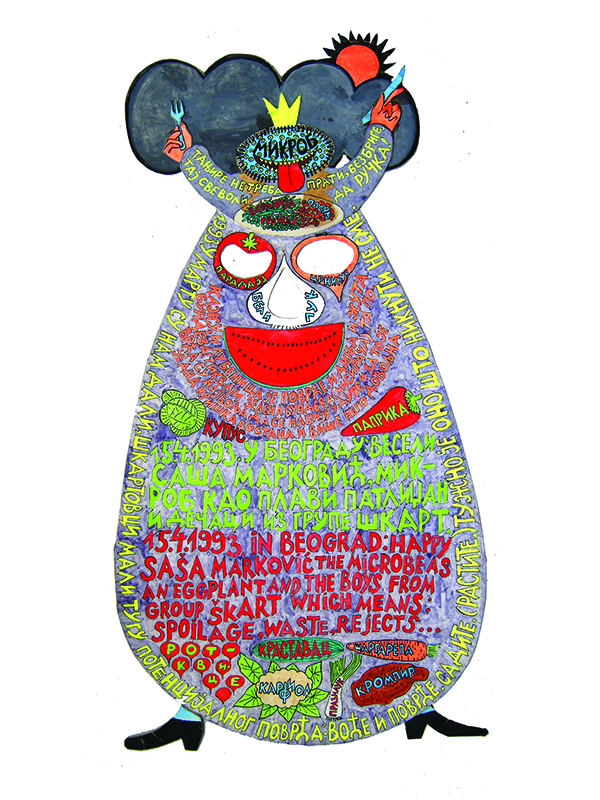
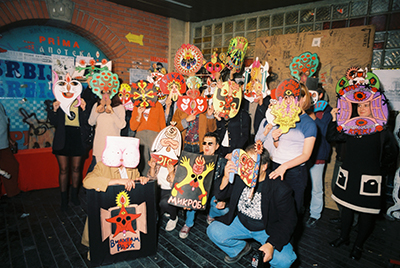
Saša Marković Mikrob, “Masks,” 1993–1994, marker and tempera on cardboard, elastic bands. Courtesy of Mikrob Family Archive
Saša Marković Mikrob (1959–2010) had a wide range of interests and gathered around him a large number of people from different generations and professions, as well as individuals of various statuses. He actively participated in public life by working with several opposition political parties as a graphic editor of the Student newspaper, as a member of the backing vocal group for Rambo Amadeus,[4] presenter on Radio B92, founder of the show The Beautiful Rhythm of the Heart, and co-custodian of one of the most important local cultural events, the October Salon. By promoting his art in various ways (performance, exhibitions, street actions, radio shows, video works, musical spots, texts, graphic works and solutions for book covers, images for CD covers, lectures on the history and phenomenon of rock’n’roll, intense debates, and monologues), Marković was, in his personal way, an active commentator on the social events in Serbia in the last decades of the twentieth century and the first decade of the twenty first century; he visually and narratively marked the period and contemporary events, the times, and the participants.
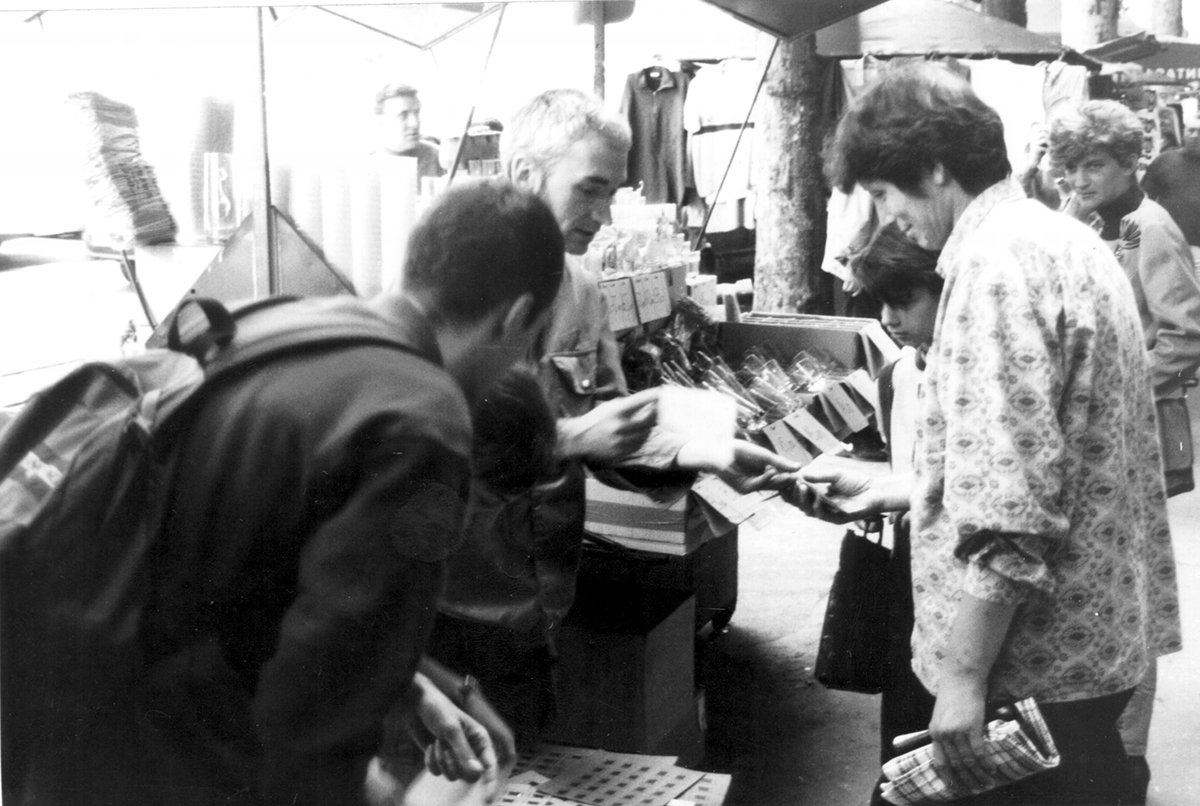
Saša Marković Mikrob, “Works from the Photo Booth,” 1987–1989, gelatin-silver prints. Courtesy of Mikrob Family Archive
Saša Marković Mikrob’s critical attitude and active social engagement began in the second half of the 1980s. During this period, he conceived and presented works created in photo booths, which involved a psychological preparation of the subjects of the future photographs, the arrangement of the photo booth cabins, and, of course, the act of photographing itself. Later, he introduced masks with various messages written on them into the cabins, which became mandatory for the final scenography. Personal and societal comments were written on the resulting strips, which were then displayed on the masks conveying the respective message. This original presentation was only accepted in April 1992, at the time of his first solo exhibition titled Works from Photo Booths, organised by the Happy Gallery at the Student Cultural Centre, Belgrade. The exhibition was the expression of experiments presented in the street, squares, railway stations… In the early 1990s, as a consequence of the sanctions, the raw materials for the operation of photo booths disappeared, and from that moment Saša Marković focused only on the messages transmitted with the help of masks. These contained critical texts specific to each performance and were offered to the public participating in the event. Some of these performances even took place during protests.
Saša Marković Mikrob and his masks used during the 1996–1997 civil protests in Belgrade. Photograph by Vlada Marković. Courtesy of Mikrob Family Archive
Saša Marković Mikrob photographed in the studio of Radio B92, Belgrade, 1993. Photograph by Goran Basarić. Courtesy of Mikrob Family Archive
Saša Marković Mikrob during the event “Appetite for Life,” 1997. Photograph by Srđan Veljović. Courtesy of Mikrob Family Archive
The Škart Group emerged in 1990 when Dragan Protić and Đorđe Balmazović founded it in the abandoned graphic workshop of the Faculty of Architecture in Belgrade, at a time when there was a clear interest in printing and poetry. The group expanded by incorporating numerous collaborators from the field, after which it was reduced in size but remains known today as Žole and Prota. Graphic works, performances, poetry, etc., were presented by many collaborators, thus creating a specific ambiance. Special attention was given to the choice of public space, the creative energy, and the experience of the participants. The affiliated concept was titled The Architecture of Human Relationships. Public actions, which were somewhere between art and activism, had a well-defined purpose, emphasising the essential problems of society and drawing attention to the ordinary—and extraordinary—people among neighbours, friends, passers-by… The project that placed the Škart Group on the artistic scene and contributed to its development was Library: Nothing Required at the Outset, specifically the project titled Sadness. From December 1992 to August 1993, the griefs were written and printed in editions of 50–200 copies. Each week they were transmitted to the distributors of the Vreme newspaper on Terazije place (Škart member Đorđe Balmazović) who displayed them during the week in public spaces. The action consisted of reading the text-messages (poems) on Radio B92 and Studio B, followed by photo documentation (responsible Vesna Pavlović). The photo-documented action was carried out by distributing a limited number of posters that were pasted at night on the facades of lesser-known buildings, as well as public ones.
The first Sadness of the potential consumers was distributed on December 24, 1992, to the sad buyers in front of a department store in Belgrade. Then followed similar actions at the abandoned capital’s train station, where Sadness was offered to potential travellers. Since then, a Sadness that always started with the letter P[5] was regularly printed on cardboard every week.
Škart, “Survival Coupons,” 1995–2000, action, street and mail distribution, off-set print on paper, perforated. Courtesy of the artists
In addition to various provocative actions during the 1990s, the Survival Coupons (1997–2000) must also be mentioned. The first in this series of 16 coupons with different dedications appeared in 1997, within the project Worried September 1997! Wilhelm Reich in Belgrade! Thirst for Life! They were named: Orgasm and Fear. The next series was titled: Happiness, (R)evolution, Faith, Word, Power, Masturbation, Relaxation, etc., and was produced with the support of friends and the involvement of citizens from different cities around the world. Together with the respective coupons, instructions for their use were also distributed. These were written in five languages and printed on perforated paper, in packages of 30 pieces distributed to friends during street actions. They contained important warnings about the situation at the time: shortages, desires, necessities, prohibitions, control of individuals and society. The last card is titled The End (the year 2000).
Škart, “Survival Coupons,” 1995–2000, action, street and mail distribution, off-set print on paper, perforated. Courtesy of the artists
The FIA Group was founded by Đorđe Milekić (alias Stanislav Sharp) and Nada Rajičić (Ray). FIA’s mission was to promote the role of photography, the press, and design in Serbia, despite the wartime conditions and shortages of the period. In their projects, the authors combined different fields—photography, design, press, and multidisciplinary events that reflected the socio-political situation. By implementing modern advertising and marketing principles like “less is more,” a large number of artists and freelancers resorted to launching provocative actions. Starting from surrealist and Zen traditions and adapting them to the confused situation in society, they made the Impossible become Possible. These actions promoted in the public space contributed to the cohesion of the artistic community, highlighting in this space the important social and political issues from the early 1990s: FotograFIA—the project that marked the jubilee of photography in Serbia, in collaboration with the Museum of Applied Art in Belgrade, L’impossible—a unique publication dedicated to photography (1992–1994), Impossible—Enough!, a campaign against the war. Calendars were also printed that presented new art in collaboration with the Publikum printing house (1993–2008). It should be noted that these calendars, which were launched each year in carefully selected spaces, anticipated the content of the following calendars.
Goranka Matić during the launch of the Calendar of New Art and Contemporary Life, “Impossible.” Photograph by Goran Basarić. Courtesy of FIA Art Group
In the devastated space of the Sebastian Gallery (formerly the property of the Croatian tourist agency Atlas), located at the intersection of Knez Mihajlova and Čika Ljubina streets, on the day of the Epiphany in January 1993, the first issue of the Publikum group’s calendar titled The Impossible —The Calendar of New Art and Contemporary Life was launched. In addition to the demonstrative presentation of Stanislav Sharp’s works made in photo booths, whose exhibition named Perspiration or the Abandonment of the Revolution, abruptly interrupted at the Sebastian Gallery in 1992, at the so-called “scene of the crime,” the promotion of this calendar was also supported by other artists, public figures, and a diverse audience. That night demonstrated the utmost concentration of creative energy in Belgrade in 1993. It was a bizarre, intense event of rebellion and protest against the surreal reality of the moment.
Launch of the Calendar of New Art and Contemporary Life, “Impossible” on the ruins of the Gallery Sebastian in Belgrade downtown, 1993. Photograph by Stanislav Sarp. Courtesy of FIA Art Group
Launch of the Calendar of New Art and Contemporary Life, “Impossible,” 1993. Photograph by Nebojša Čović. Courtesy of FIA Art Group
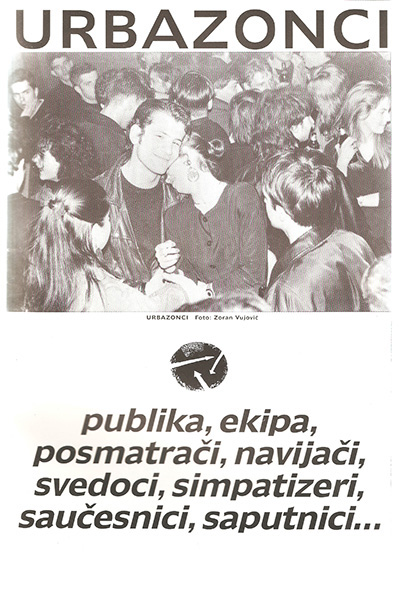
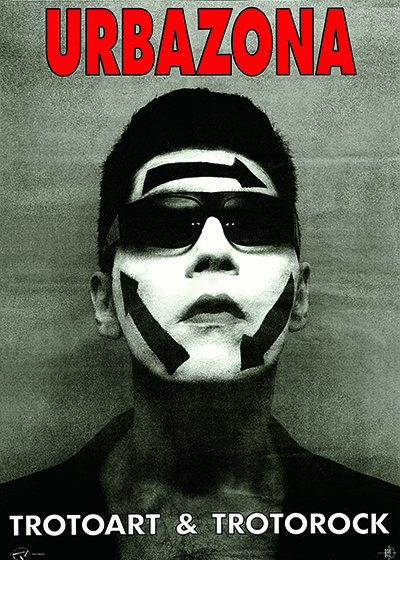
Miomir Grujić Fleka (1954–2003) is a phenomenon that marked the culture of the 1990s in Serbia and shifted many boundaries of the perception of artistic creation. As a painter, journalist, promoter, and provocateur, Fleka proved to be a true trailblazer on the urban artistic scene that took shape on the fringes of society in the 1980s and 1990s. He is the author of many initiatives that had a major influence on the development of urban culture, such as the founding of the Academia Club, Radio Šišmiš, and the launch of the Urbazona project. In his articles published in various magazines and newspapers with which he collaborated or for which he was an editor, he launched provocative ideas with graphic content and committed texts. His activity as a representative of the visual arts contributed to the launch on the artistic scene of the 1980s and the creation of a new sensibility in artistic creation. In the early 1990s, neither the lack of mobility nor the loss of sight prevented him from finding new ways of artistic expression in the public space as an artist initiator of several projects that reflected civic consciousness, at that time on the verge of extinction: he launched a special project on Radio B92 on 11 December 1989, a performance show called Radio Šišmiš, presented every Monday from midnight until 3 AM. The show was suspended in 1991 due to the protests that took place from March of that same year until 1993. Beginning with that year and until the end of 1999, the show was resumed every Monday. Its almost frenzied and energetic rhythm did not allow for listener passivity. According to his statement, Šišmiš is a metaphor, a vigilant witness watching from the core of time, people and their behaviour, without the intention to comfort. The description of the general state of society refers, as he himself specified, to stupidity, primitivism, greediness, and untruthfulness—the four categories that characterise this ongoing apocalypse—resorting to cynicism, irony, and defiance of the norms of the station’s broadcasts. Fleka had a profound communication with the public. In June 1993, he initiated a new wave of artistic actions through the project Urbazona—Energy 93, which manifested in various forms until the end of the 1990s.[6]
Miomir Grujić Fleka photographed during the filming of the documentary “Zombie Town,” directed by Mark Hawker, 1994–1995. Photograph by Vesna Pavlović
Poster of URBAZONA, 1994
Miomir Grujić Fleka photographed on the poster of URBAZONA, 1997. Photograph by Talent Factory
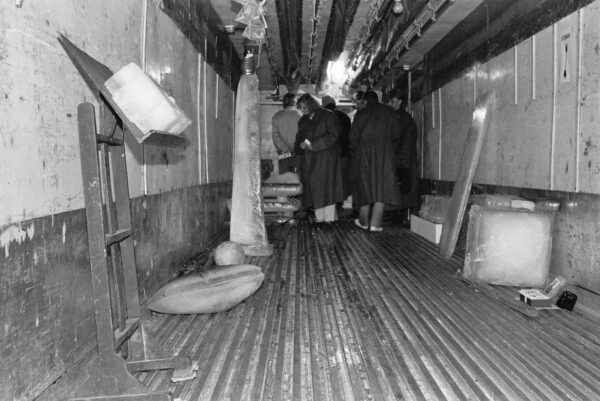
LED ART presented itself to the public in Belgrade in 1993 with the project Frozen Art. Preparations began in May of that same year when inside a refrigerated truck of the Belgrade Agricultural Combine in Boleč, about twenty artists from different generations, with various vocations and equally diverse statuses, froze their works or created new ones from ice. The intention was to present their works to the public in an alternative gallery, which would be suitable for the public’s reaction to the situation in society, namely in a refrigerated truck.
The huge refrigerated truck was placed in the city centre, at a busy intersection known for frequent traffic jams, and it blocked traffic, creating a tense situation amidst the general atmosphere of absurdity and chaos, reflecting visible fractures on both an individual and social level. Thus, the refrigerated truck became an art gallery and symbolically represented the change of a “state of matter.” On that evening, the refrigerated truck turned into a gallery. The public entered at a temperature of minus 20 degrees Celsius, in groups of 10 people dressed in military overcoats, behind which the door was blocked until the next group of visitors arrived. The atmosphere inside, the sensation of discomfort, despite some humorous or allegorical artistic works, managed to brutally confront the visitors with reality. Claustrophobia, uncertainty of exiting that space, fear, were the keywords that reflected the reality of society.
LED ART, “Fronzen Art,” 1993, action, Belgrade. Photographs by Vesna Pavlović. Courtesy of LED ART Archive
In its manifesto, the group states: “LED ART is a creative force. It represents creation as a way of resistance and overcoming the situation—the continuation of creation despite any event. An industry dedicated to creation.” Frozen Art is the first organised revolt of a large group of artists, being categorised as the most significant act of art presentation up to that point outside the official space and its launch into the public space. Precisely through this bold public civic action, followed with great interest by the free media, contemporary art proved to be an important stage for expressing the current socio-political stance. In the following period, the composition of the group led by Nikola Džafo changed continuously—but not the forms of its activities, which were focused on criticising society.
LED ART, “Fronzen Art,” 1993, action, Belgrade. Photographs by Vesna Pavlović. Courtesy of LED ART Archive
LED ART proves to be a grouping, a movement, a phenomenon, an event that manifests at the abrupt, dramatic limits between art, ideology, and politics. Under this name, it would continue to operate until 2003, reacting provocatively and establishing communication through actions, exhibitions, performances, inquiries, polemical texts, publications… It must be emphasised that all actions take place in the public space (on the street, in garages, on skating rinks, even at garbage dumps…), and their purpose is to launch constant provocations, focused on the sensitive problems of society, guided by the principle of “ethics before aesthetics.”
The interruption of this “Yugoslav legacy,” isolation, and the “antechamber war” of the 1990s led to a reformation of visual arts. From a politically imposed situation, a parallel artistic scene and a new artistic community were created. Defined at that time as a subculture, alternative culture, or underground (though it included the academic environment), it was essentially a community of resistance against social hypocrisy—a community that fought to preserve normality and represented opposition to the primitivism and nationalism present in society. Paradoxically, this distorted state of affairs led to the birth of a new logic in cultural evolution, the conquest of a new space for action, and an active mode for art to influence society. Thus, an extraordinary melange occurred. A new front was created, a new way of manifesting art was launched, which impacted public opinion and marked the student protests in Serbia (17 November 1996–22 March 1997). In other words, all these phenomena transformed into a “huge stage” of performances where both artists and citizens participated.
Action “With the Mirrors at the Cordon” by LED ART Group and performance by Sonja Vukićević (ballerina) and Slobodan Beštić (actor) playing “Macbeth” by William Shakespeare during the civil protests in Belgrade, 1996–1997. Photographs by Vesna Pavlović
A new shock for the citizens of Serbia was triggered on March 24, 1999, when the anti-aircraft sirens began to sound, announcing the start of NATO bombings on the FRY, which continued until June of that same year. During this period, marked by shortages of water and electricity, there began three months of suspension of any public action. It was a time for introspection, self-analysis, a period of reflection. The last cultural events attended by a large audience took place during the protests of 5 October 2000, when Milošević was removed and the era of “democracy” began. The experience of the effervescence accumulated until then began to slowly “melt” and transform into a “new normality” after the year 2000. A new dimension thus emerged: instead of direct human communication (between individuals, direct and reciprocal looks, touches, smells), a new era began where engaged communication between masses and individuals disappeared. This was replaced by planned actions with carefully established purposes. The increasing presence of computers generated a new mode of communication. Project financing systems appeared. All these imposed a new logic in artistic activity.
In the 1990s, in the context of a profound despair of people, the primal instincts became predominant. In the 2000s, we entered the system. Mediators, “cultural managers,” and notions such as projects, aims, target groups, outcomes, indicators… emerged. Overwhelmed by bureaucracy and conforming to the conditions of donors to realise “projects” they were to fund and through which we secure our existence, the enthusiasm of the past faded, the combative spirit diminished, or simply, we accepted the “castration” of creativity and the sacrifice of creative instincts to adapt to the logic of “creative industries” and administrative foundations.
Awaiting the new era of the 2020s, as long as the memory of the witnesses remains alive, it would be useful to deal with the history of these changes and the “lessons learned” in the meantime. We must leave behind documents regarding the essential tendencies of the great changes. If we do not make art, we risk going in circles and repeating with less and less vigour what we have already experienced. We are left only to hope for the surprise factor and to fight at a higher, global level, without accepting to conform to what will be offered to us and what is expected of us.
Perhaps the time has come to form a new community, this time at an international level.
Darka Radosavljević graduated from the Faculty of Philosophy in Belgrade, Department of Art History, and completed the European diploma in cultural project management 1999–2000. Her specialisation and interests encompass contemporary art practices and cultural policies. She edited numerous specialised publications and has been publishing frequently in various printed media. During 1990–1999 Radosavljević was a journalist, then editor of the Cultural Department of Radio B92. Initiator and the first editor of the Cinema REX-a (1994–1999) and artistic director of the international manifestations Belgrade October Salon 2005 and Belgrade Summer Festival 2007. She is the founder and executive director of REMONT—an independent artistic association since 1999.
[6] “As a movement, Urbazona is not an artistic fraternity, nor a selection of individuals, nor a programmed, precisely defined team, but a collection of individualities, ideas, and poetics whose language and energetic charge do not fit with the rest—in the intolerant and in all respects tragicomical cultural value system.” Miomir Grujić Fleka, Instructions for Reception and Subsequent Distribution, leaflet for Action No. 5, 1993, published by Radio B92.
Performing the 1990s. Romania⎯State of Exception
DIleana Pintilie
Thinking of Romania’s specific circumstances, the collapse of the infamous Bucharest regime and, at the same time, the fall of communism (experienced through a violent process that engaged a large part of the population) signified the opening of another era, challenging in all aspects of life—political, social, and cultural. A new period of transition towards something completely different—towards a society that needed to be reformed—was unfolding, and the hope of freedom and alignment with the Western European values became the aspiration of the entire country.
It was therefore essential to reconsider the connections among the different groups at the societal level, to invalidate the sole Party that had been in power for over fifty years, promoting instead the heterogeneity of political milieu, and the emergence of non-governmental organisations. These aspects, alongside with the activity of the independent press (especially in the first part of the decade), have essentially contributed to the change of life in all its aspects, in reclaiming the freedom of thought and speech, and of the public space, abusively and autocratically controlled before 1989 by the political apparatus.
Nicolas Bourriaud[1] observed that the fall of the Berlin Wall, experienced with emotion in Eastern Europe, actually represented the first decisive step towards globalisation and the spreading of postmodern thinking. Postmodernism made its presence felt in Romania as early as the 1980s, being adopted by an entire generation of writers and visual artists who, through specific manifestations, became a contesting force, which caused the communist regime to be more vigilant, intensifying censorship.
The critique of the socialist society on the edge of collapse, the revolt against the harsh neo-Stalinist order during Ceaușescu’s dictatorship characterised the 1980s generation (but not only), a generation that manifested itself radically through artistic networks—authentic alternatives to the official public space. Artists found private spaces (their own studios[2] or homes, sometimes anonymous spaces like public telephone booths[3]) where they continued to exhibit and to attract the interest of the public.
The proliferation and diversity of visual means during this period led to hybrid forms of mixed-media that implied the blending of images like photography and film with installations or performance art, aside from the established artistic mediums. After 1989, when the main obstacles (ideological control and censorship) had been removed and the freedom of speech was allowed again in the public space, there was among artists a will to retrieve what had been forbidden in the previous decade.
Thus, during the 1990s, artistic forms previously experimented were brought to light and received increased attention. Manifestations that had been underground for years, such as performance art, finally became public, and this genre, disavowed by the political power during communism, suddenly sparked the interest of an increasingly wider audience due to its direct mode of address and because of the novelty and timeliness of the messages conveyed directly by the artists.
If internationally performance art had exhausted its mode of manifestation in the 1960s and 1970s, a time when Western artists felt this genre as a crisis of language and communication, in the Romanian artistic context, but not only, at the beginning of the 1990s, experiments carried out in the solitude of the studio, unknown to the audiences, began to emerge and be recontextualised or to stimulate other artists to perform in a similar way. At the same time, after a period of total entrenchment of public life, viewers became more open to such direct lived experiences, and performance art transformed into a mode of communication within a society that was suddenly discovering its rights to freely speak on the streets.
As said, there was an urgency in recovering performative art in the public space, and in the turbulent context of the first years of democracy, the artist’s body became the most convincing material, closest to people’s questions and difficulties regarding society and the political context. The body condensed and summarised, through its specific expressiveness, the states of anguish and the dilemmas of the people, the absurdity that surrounded it at every step, and offered an immediate release from these tensions. This was because, before an intellectual or artistic concern, people were looking for answers to the urgent issues around them.
For a short time, artists took on the mission to be “the public voice,” bringing up topics of tremendous interest, such as the political ones from the tumultuous times of transition, tainted by visible or invisible complicity with the old regime. Such a “voice” was Ion Grigorescu, interested in re-evaluating his own work from the previous decades. He tried to understand if his topics from the communist times remained legitimate, and if he could provide a response to the ideological and social changes during the period. The artist conceived in the 1990s two exhibitions: Anatomy of Opposition, Submission, Exposure (Căminul Artei, Bucharest, 1990–1991) and Politics, Religion and Art in the Face of Crime (Catacomba Gallery, Bucharest, 1992). As the titles of these exhibition-installations suggest, the artist considered himself absorbed by the new problems of ex-communist society, aspiring to expose those attitudes where dissent mixed with tacit involvement, betrayal, or brief moments of heroism.
Grigorescu conducted his own research on Romanian society at the time, considering himself morally affected by the recent past, haunted by “its spectres,” so that his installation titled The Country Is Not Just for the Militia, the Security Forces, and the Communists, exhibited in the Unirii Square in Timișoara,[4] focused on an important theme debated in the Romanian and Eastern European space, namely the role played by repressive institutions in maintaining totalitarian regimes in power and their silent survival in the post-communist times. The title of his installation revealed his anger against a corrupt and complicit society, which failed to break away from its ambiguous past, kept alive by obscure political forces that wanted to maintain their privileged positions.
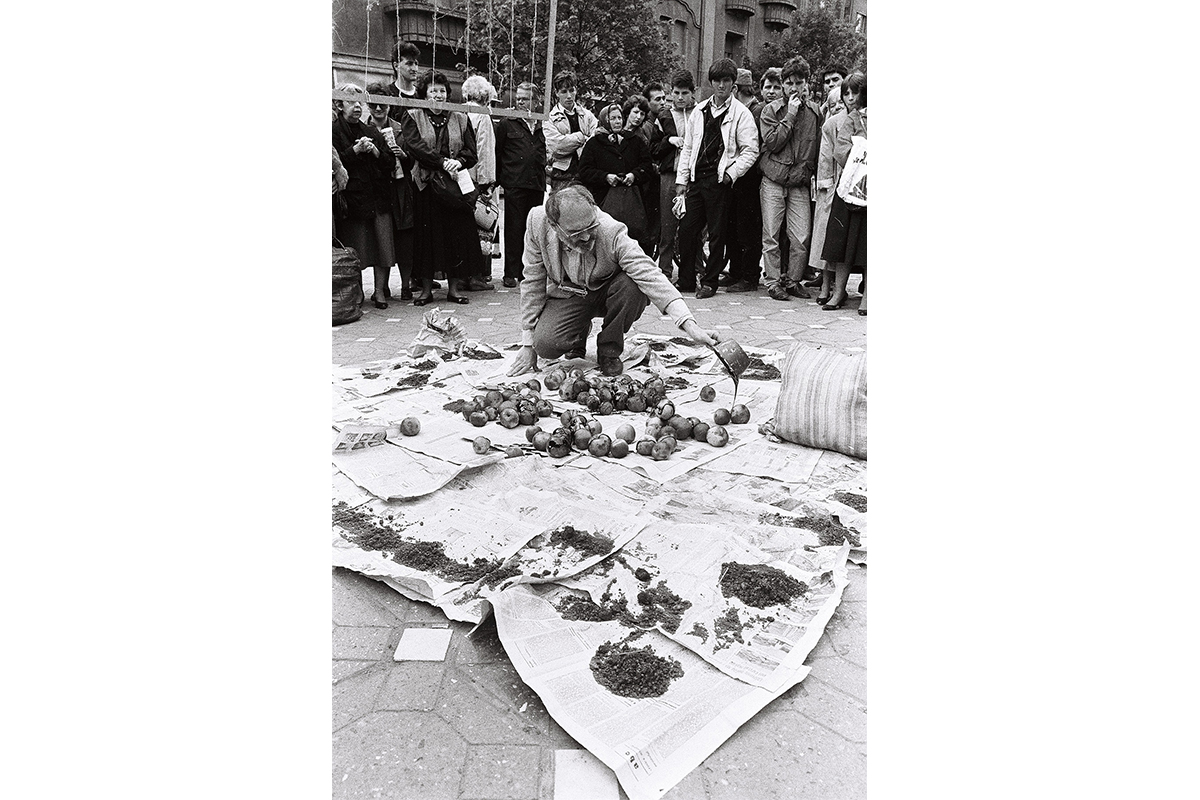
The first elections after 1989 and the disappointment caused by their outcome (which showed the widespread choice of the population for a “recycled” ex-communist party) generated other art projects, instant critics to a reality difficult to tolerate, yet performed in a symbolic key. The relationship between the individual and power, in light of those events, was treated in the action and installation The Blind Man’s Sunday (1991), which Constantin Flondor carried out in the central square of Timișoara, right under the eyes of random passers-by. The artist chose a metaphorical visual language and paired groups of apples coated in beeswax with groups of apples sprinkled with black pigment (the “positive” and “negative” elements), an allusion to the way most Romanians had voted for the first time, falling victims to populism. The installation was completed by a structure of grapevine tendrils and texts written directly on the sidewalk referring to the biblical text, to the significance of The Blind Man’s Sunday,[5] as it is noted in the church calendar. Being aware of the critical spirit of the installation, the public vandalised it shortly after.
Constantin Flondor, “The Blind Man’s Sunday,” 1991, street installation in Victory Square, Timișoara, presented during the exhibition “State Without a Title.” Photograph by Iosif Király. Courtesy of the artist
The monumental installation of Ana Lupaș, The Monument of Cloth, erected at the beginning of 1991 in the University Square in Bucharest, has a tragic nature. Instead of white canvases, a sort of black tar-impregnated canvases were stretched on support bars.[6] In that specific location, the installation referred to recent history, to the sacrifice of those who fell during the 1989 Revolution, but also to the “occupied” type of demonstrations that took place there and were repressed by the neo-communist regime in power. This installation, which had a strong impact on viewers—although the language used was minimalist and without any added explanatory commentary—revealed once more the involvement of artists in the political and social events that were stirring Romanian society at that time.
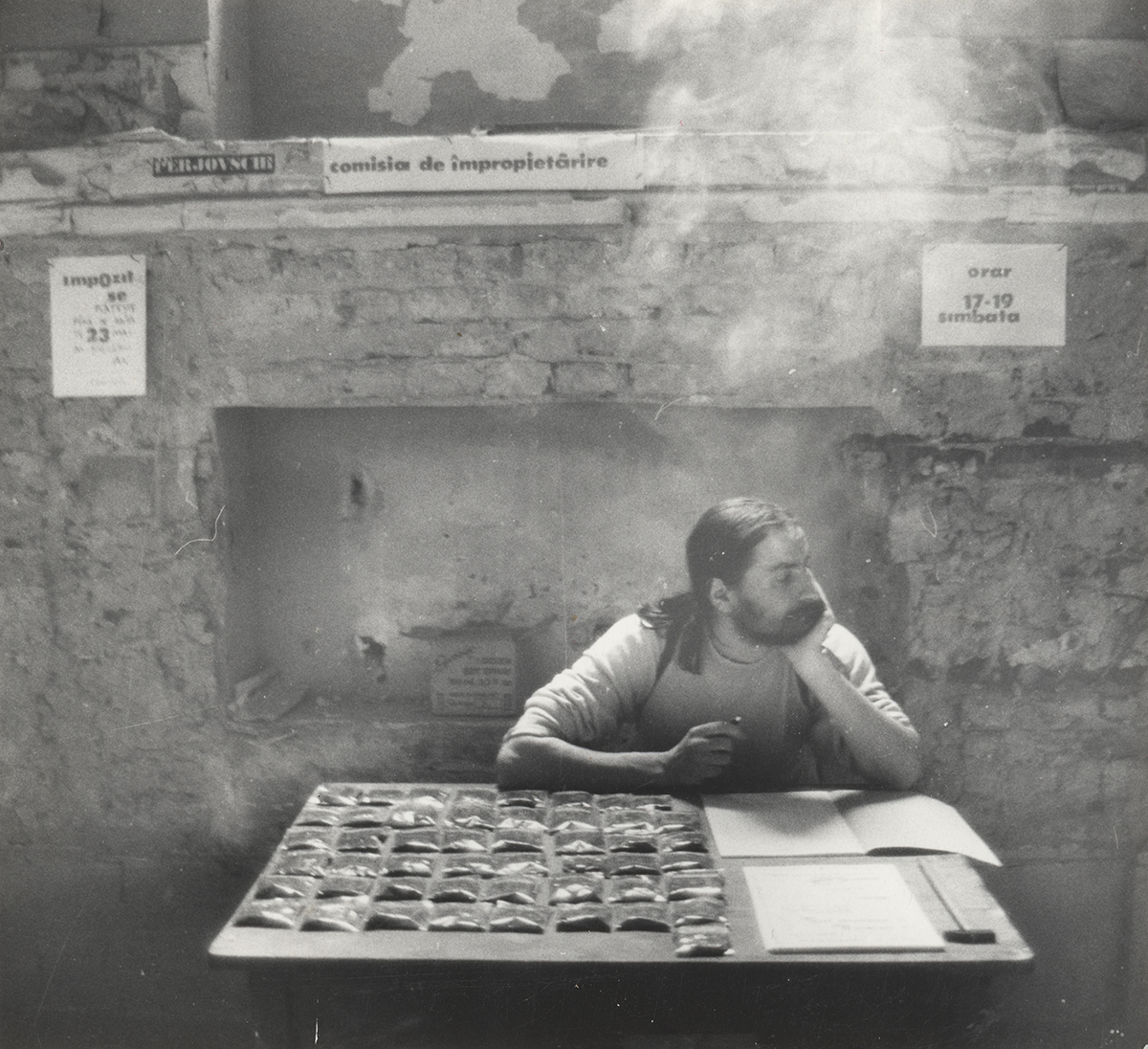
Debates on the topic of restitution of properties and lands confiscated during communism generated significant controversies throughout Eastern Europe, and Romania was no exception. An initial version of the law voted after 1990 was close to the socialist vision of property, which produced frustration and dissatisfaction. Some artists felt that it was their place to symbolically get involved in these internal debates, adding their comments, and Dan Perjovschi performed an ironic action titled The Appropriation (of Land) Committee (1992), “endowing” visitors with little bags filled with soil and a property title signed by the artist.[7]
Dan Perjovschi, “The Appropriation (of Land) Committee,” 1992. Photograph by Petru Teleagă. Courtesy of the artist
In the first years of the transition, feelings of dissatisfaction and insecurity, the sense of a predictive failure of the society, still under trauma, were expressed by several artists belonging to the 1980s generation: Dan Perjovschi, Teodor Graur, Iosif Király, the subREAL Group, Sorin Vreme, and many others. Still, Dan Perjovschi’s activity during this period remained exemplary through at least two actions in which he tried to define the sense of individual and collective guilt. In the time-consuming action State Without a Title (1991), he locked himself for three days in the doorman’s chamber at the Museum of Art in Timișoara, which he wrapped in white paper sheets to continuously draw over them. The result was the transformation of the white/immaculate space into a black, threatening one, in which the drawings, often superimposed, were no longer clearly distinguishable, a space charged with the sentiments of abandonment, regret, and frustration, intuitively expressing the general mindset of the time.
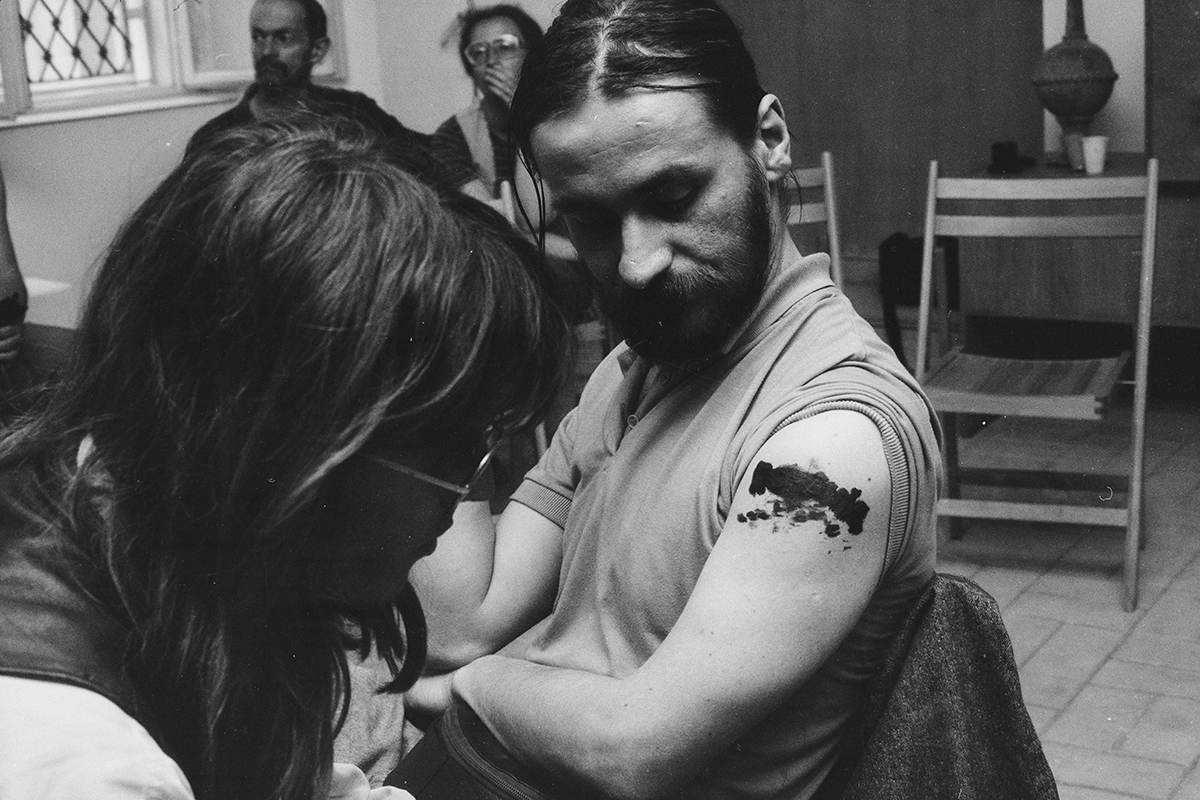
In the action România,[8] in which Perjovschi had his shoulder tattooed with the name of the country, he signalled, in a personal and courageous gesture, his revolt against an authoritarian neo-communist government and political system that seemed to ensure the continuity of old habits, only slightly cosmeticised. He brought into question the issue of personal freedom in a precarious, bleak social, political, and economic context, where he believed to be recorded, enclosed, deprived of mobility and even of decision, reminiscent of a concentration camp.
Dan Perjovschi, “România,” 1993, 1st edition of the Zone—Eastern Europe Performance Festival, Timișoara. Photograph by Stelian Acea. Courtesy of the artist
Teodor Graur’s action Speaking to Europe from Europe (1993), carried out in the central square in Timișoara, presented with irony and humour the isolation of Eastern Europe from the rest of the continent. The lack of communication, the seclusion of those years, similar to a prison space, led Graur to carry out this performance. Enclosed in a huge metal mesh cage only with a radio, the artist tried to establish communication using a microphone; ironically, though surrounded by the public, he received no sign of response to his calls, only the radio waves of distant foreign stations “answered” him.
Teodor Graur, “Speaking to Europe from Europe,” 1993, 1st edition of the Zone—Eastern Europe Performance Festival, Timișoara. Photograph by Stelian Acea. Courtesy of the artist
These introspective actions or installations, carried out in the first years of transition, paved the way for several artists to speak about the political and social situation of those years and prepared the painful self-confessional examinations related to the recent past.
The performance The Abandonment of the Skin, carried out by Alexandru Antik at the Zona 2 Festival in 1996, discussed the acceptance of guilt and the abandonment of the past “epidermis”—an artificial skin that the artist struggled to peel off his body to nail it to the floor. His gestures of liberation symbolically contributed to the transformation, even transfiguration of the artist’s persona through a self-examination.
Alexandru Antik, “The Abandonment of the Skin,” 1996. Photograph by Barabas Zsolt. Courtesy of the artist
Lia Perjovschi’s action My Right to Be Different (1993), also presented in Timișoara, brought to the audience’s attention the theme of the double (a cloth doll the size of the artist) onto which she discharged her inner tensions and which she soaked in black pigment to then throw against the walls or towards the viewers. The alternation of manifestations of violence with those of tenderness, poured onto this double, suggested a corrupted relationship, influenced by the abuse of power which can only lead to servile and passive obedience. The doll—understood as the double of the artist—became a standard for these self-referential states.
Lia Perjovschi, “My Right to Be Different,” 1993, 1st edition of the Zone—Eastern Europe Performance Festival, Timișoara. Photograph by Stelian Acea. Courtesy of the artist
The danger, the state of tension caused by a smouldering violence, emanated from Sorin Vreme’s installation titled Ring, included in the exhibition The Earth (1992). In one of the inner courtyards of the Museum of Art in Timișoara, the artist created a triangular enclosure of barbed wire, a symbol of prison spaces; the sharp angles of this enclosure, floored with black wood, which doubles the shape and refers to an unclear, mysterious area, transmit a potential aggressiveness ready to be triggered. This remote space—a possible passage towards an unknown area, was at the same time an arena for violent and rough confrontations similar to a battle ring.
After having previously dedicated himself to solitary actions and self-photography in his own studio, Iosif Király turned his attention, in the 1990s, to the public space and began a series of photographs observing with eagerness and increased intensity the Romanian society during the transition. The series of black and white photographs titled Indirect, started in December 1989 and continued until the late 1990s, unflinchingly recording the uneven reality of those moments, especially in Bucharest. The train or subway proved to be inexhaustible reservoirs of strange or ironic subjects, revealing the social precarity of those years. Later, his camera gathered images from other major cities around the world, as if the artist were applying a super wide-angle that significantly broadened his visual field.
Király became, shortly after 1990, a member of the first artistic group established after the Revolution, the subREAL Group.[9] The group became recognised and appreciated for its corrosive analysis applied to Romanian society in the 1990s, deconstructing the old regime’s popular or historical triumphalist myths (The Hero from the Carpathians, Draculaland, 1992–1997), but also mocking Western cultural stereotypes about Romania, especially the fabricated myth of Vlad the Impaler, overlaid on the fictional story of Dracula. The subREAL Group attempted a critical strategy to a society that was back-then ossified in the narrative structures produced during socialism by the regime’s ideologues to stimulate national pride, but also to divert attention from the real significant problems of society.
In conclusion, Romanian art from the 1990s experienced a fruitful process of development and transformation towards a complete liberation from conformist stereotypes, but also in terms of media. Intermediality was increasingly present and captivated the interest of these artists who mixed genres, techniques, and even concepts. This period was extremely important for the unprecedented opening towards the international scene and slowly, but unquestionably, towards regional collaborations.
Ileana Pintilie is art critic and historian, professor at the Faculty of Arts, the West University of Timişoara. She was the founder and curator of Zone—Eastern Europe Performance Festival, Timișoara (1993–2002). Senior Research Fellow, Gender Politics and the Art of the European Socialist States, The University “Adam Mickewicz,” Poznań and The Institute from Art History, Zagreb (2019–2021), supported by The Getty Institute. She is the author of many studies and articles about Romanian and Central-European modern and contemporary art published in Romania and abroad. Her books include: Actionism in Romania during Communism (2000), Ştefan Bertalan. Crossroads (2011), Ștefan Bertalan. Visual Structures 1960-2000 (2020) and Constantin Flondor. Path to the Shape. Multimedial Artistic Concepts (2022).
[1] Nicolas Bourriaud, The Radicant (New York: Lukas & Sternberg, 2009).
[2] Constantin Flondor, Life Without Art?, mail-art exhibition, artist studio, Timișoara, 1984.
[3] I am referring to the work of Imre Baász, Handout (1981), later called The Birth of the Myth, following its glueing in a telephone booth in the city of Sfântu Gheorghe. For more on this, see Chikán Bálint, Imre Baász. The Bars Breaker (Budapest: Szabad Tér Kiadó, 1994).
[4] The installation was exhibited on the facade of The Museum of Art in Timișoara as part of the exhibition State Without a Title, 1991. Organisers: Simona Nuțiu, Sorin Vreme, Marcel Breilean, Ion Oprescu and others. Locations: The Museum of Art and the Victory Square in Timișoara. The exhibition was organised as a meeting of artists from Cluj, Bucharest, Timișoara, Oradea, a kind of Atelier 35 in absolute freedom, an exhibition not censored by anyone. There was no pre-selection of the works, which was reflected in the quality, but what mattered then was the joy of each artist to exhibit freely. Several important artists of the 1970s–1980s generation participated in this exhibition and produced several memorable works.
[5] Flondor chose this title because the first elections took place on that very Sunday.
[6] Ana Lupaș began the series titled Humid Installation with an action in the village of Mărgău, in 1970. This significant work reflected the harmony between the natural space and the gestures of the people, who were also metamorphosed through a common activity intended to unite them. The series of installations based on this concept continued over the years in various outdoor environments or indoor spaces.
[7] The action took place as part of the intermedia exhibition The Earth, Timișoara, 1992.
[8] This action, which became exemplary for the period we are referring to, also took place in Timișoara during the 1st edition of Zone—Eastern Europe Performance Festival (1993).
[9] The subREAL Group appeared in the summer of 1990 at the initiative of Dan Mihălțianu and Călin Dan, and shortly afterwards Iosif Király joined. Their first works were oriented towards a critique of the communist regime that had just collapsed—caustic comments on the humiliations accumulated during Ceaușescu’s dictatorship (Alimentara/Grocery Store). In 1993 Dan Mihălțianu left the group opting for a solo artistic career, and subREAL continued to function as an artistic duo gradually focused more on conceptual projects based on photography.
The 1990s as Loose Coupling: Our Aesthetic Categories and Systems Theory
EOvidiu Ţichindeleanu
The 1990s in Eastern Europe are paradigm-shifting years. The political sphere, the legal basis, the economy, the culture industry and the society have each gone through a systemic transformation. This is not a common historical experience. Consequently, I argue that analysing this period using theoretical constructs, themes or criteria borrowed from the study of other historical periods, particularly from Western-centric sources, is simply not appropriate or good enough. I would also suggest that looking for legacy in the 1990s—for what is “important” for the 1990s in Eastern Europe—is an endeavour that risks missing substantial clues. When looking back with the clear gaze of thirty added years of historical experience, Fukuyama’s famous “end of history” thesis, pronounced in 1992, reveals itself through its utter and rather sinister poverty of understanding its own times. Only an extended analysis of the local cultural archives of the 1990s, following the unfolding of their internal logic in relation with the preceding and consequent historical events, and with significant external factors, could possibly lead to the appropriate concepts for such a special and rare human experience. In other words, a distinct body of critical theory is needed.
However, given that the West weighed enormously and colonially upon the material and cultural re-foundation of the 1990s in Eastern Europe, an orienting path and provisional middle ground can be provided by the most influential theory of Western organisation of the 1970s–1980s, Karl E. Weick’s The Social Psychology of Organising, which at its turn took up R. B. Glassman’s behavioural concept of loose coupling.[1] Weick found that the concept of loose coupling was able to address the main contradiction found in the real life of organisations from the capitalist world: they simultaneously were closed systems based on certainty, determination, and rational calculations, while they also turned out to be open systems which expected uncertainty, even changed goals, and spontaneity. While the dominant approach tried to discipline organisations and to purge from them the influence of “external variables” and of any indeterminate, thus attempting to turn the organisations towards a regime of austere rationality (one could say: a regime of total control), Weick proposed the idea of loose coupling in order to conceive the seemingly inconceivable but real-existing relation between rationality and its “outsides,” and thus presumably to open towards another kind of practices of running and reforming organisations, perhaps less authoritarian. As a neuroscientist, Glassman had argued intriguingly that the systems that are loosely coupled to other systems are the ones which tend to persist, being able to better absorb any external shocks. For his part, Weick also noticed that groups based on “weak ties” between their members tend to handle better external crises. Later, delving analytically into the epistemology of loosely coupled systems, Weick found that loose coupling is produced in interactions that are sudden (as opposed to continuous), occasional (as opposed to constant), negligible (as opposed to important), indirect (as opposed to direct) and eventual (as opposed to immediate).[2]
If we are to consider that the 1990s have really been the “transition” between two radically different ways of organising the society and the socio-economical totality, with radically different forms of value, and that the 1990s are indeed the historical link between two systems, then Weick’s analytical findings, which delved into a deeply operating contradiction from the Western world, are well suited for analysing the aesthetic categories that gave shape and substance to the 1990s. The sudden, the occasional (or ephemeral), the negligible, the indirect, and the eventual (or the ultimate) are overwhelming presences of the cultural matters of the 1990s. Their structural and structuring role is striking, and yet it has been overlooked.
I am not alone treading on this perilously generalising theoretical path. Writing in 2010, and thus only a few years after the biggest crisis of the capitalist system in recent history, Sianne Ngai made a related argument for the contemporary shape and substance of the Western cultural, social and economic life. Ngai argued that the triad of zany, interesting, and cute, as trivial and marginal aesthetic categories as they might seem upon first glance, are actually best suited for conceiving how the concept of the “aesthetic” has been shaped by what she calls “the performance-driven, information-saturated and networked, hypercommodified world of late capitalism.”[3] Thus, Ngai’s argument concerns the value forms of the entirety of the Western culture industry and of the globalised economy and societies: the zany, the interesting and the cute are crucial for the genres of comedy, realism, and romance; they are determinant for the worlds of performance, media or information, and domestic life; and indeed they shape, respectively, the matter of the “socially-building processes of production, circulation, and consumption.”[4] One can read Ngai’s analysis as an observation of the loose couplings at work in the historical times of a global transition of the world system, rather than deducing from their flimsiness or triviality a presumed decline of the fundamental (Western) values. However, even though each of these categories are mediating contradictions, they remain operative in a positive ontology, which remains a privilege of the epistemology of imperial and colonial powers, and marks the cultural difference between the vision of the imperial and colonial winners, and the vision of the defeated (whether colonised, enslaved, peripheralised, etc.)[5].
In a visionary article written in the tumultuous year 1991, the Romanian Marxist philosopher Radu Florian, who taught at Bucharest University from the 1950s to the 1990s, argued that the relations of power within Europe had been based historically on the art of maintaining the equilibrium between the several great (colonial) powers within the same integrated world system. Thus, throughout the colonial era, the great powers had been integrated in the system and each tried to be dominant within the existent equilibrium, as opposed to obliterating it by annihilating one of the participant states (or challenging the system itself).[6] However, after the First World War, the equilibrium was destroyed, and the ensuing catastrophe only led to the absolute destruction of the Second World War. In the period of 1990–1991, Florian recognised a similar historical phenomenon. In the conditions of a new disequilibrium in Europe, he argued, life in Romania was characterised by the sudden destructuring of the old economic and inter-state relations, the occasional emergence of forms of market economy, the negligible functionality of institutions, the manipulations of political discourse with indirect purposes, and the eventual causation of traumatising ruptures. Consequently, he presciently argued, “the most probable perspective for Romania is to become a subordinate peripheral economy, with a minority of the wealthy and a majority of the poor.” However, at his turn, the old Romanian Marxist was focusing only the workings of a temporary negative ontology which could be resolved through political agency into a restoration of the equilibrium. In other words, Radu Florian tried in 1991 to envision the end of a transition that was barely beginning.
Therefore, if one is to learn from Florian, but also from Weick and Ngai, a perceptual and methodological shift is needed in order to understand the 1990s in terms of its loose coupling between radically different historical systems. Instead of focusing on the traditional systemic domains of the economic and inter-state relations, the market economy, the institutions, the political discourse, and the traumatising ruptures, one would need to shift the perception towards the aesthetic of the sudden destructurings, the negligible functionalities, the indirect purposes, and the eventual (not immediate) causations. The focus on such loose couplings brings the archive of the 1990s closer to the processes of value-forming, and evidences the coherence of seemingly heterogenous and previously ignored or marginalised phenomena. Thus, to mention a few that are studied elsewhere: the sudden predominance of self-diminishing, destructive and insulting discourse and practices; the acquired importance of ephemeral publications, fringe sciences, and “leisure” or “yellow” content of all sorts, with very questionable social functionalities; the explosion of forms of collective organising in relation to these genres and phenomena, which served to other purposes, such as survival schemes; and the general orientation towards Western visualities and their media materialities, which prescribed the sense of the end of the post-socialist transition. Western visual matters entered into places like the formerly enclosed Romania suddenly and in massive quantities in the 1990s, especially via the new mass media of cable and satellite television, via the personal computer, but also through the mass import of commodities such as the “second-hand” clothing markets, for instance the famous “Europa” market from Bucharest, as well as the aggressive entrance of Western brands such as Coca-Cola, which became one of the most ubiquitous commodities sold in the new form of “micro-business” and “free enterprise” represented by the kiosks.
It comes then as no surprise that the artistic practices of the early 1990s focused much on disintegration, dysfunctionalities, organisation and re-institutionalisation, while often connecting ideals about the open potential of democracy with the establishment of new media. In Hungary, during the anti-communist frenzy of the demolishment of statues, which included the statue of Lenin from Debrecen made by István Kiss, then Rector of the Hungarian Academy of Fine Arts, the students revolted and debated in the Academy the general organisation and principles of arts and art education. In the debates, the desire to eliminate any ideological and bureaucratic restrictions lead to an affirmation of arts as the needed democratic domain of pure and unrestricted creativity; then again, the same students asked for a number of exclusions and for the bureaucratic inclusion of new media (video, computer, etc.) in the curriculum, and one of the “positive results” of this live reorganisation was the Intermedia Department. Rebels[7] rightfully recuperates the performativity of the debates themselves in the appropriate format of a photo-comic book. Moved by seemingly similar forces, the curators of the first retrospective of the first decade of Lithuanian art after 1989 did not settle on a unifying theme or even on a series of concepts, but on the order of materialities themselves. In other words, they did not choose a “strong” signifying subject, deciding instead to organise the large exhibition in two components: the first track presented the “traditional artistic genres of painting, sculpture and graphic art,” yet in the “newly inspired large-format” and with “increasingly object-oriented” works, while the second track presented chronologically video art, a sound archive saved on a compact disc, and photographic documents.[8]
Towards the middle of the decade, artists found themselves in a permanent competition for grants applications, in conditions of radical impoverishment, and banded together in “platforms.” Platforms rather than individual artists became thus the dominant “units of production” and the main performers of the re-emerging art scene.[9] In Romania, the changes in the independent scene of contemporary dance are also particularly significant, in particular with regards to the generation of Mihai Mihalcea, Cosmin Manolescu and later Manuel Pelmuş, with Mihalcea creating the Solitude Project,[10] a cultural association that operated in the loose continuum between performance, organisation and activism. Only the created context of such weak ties allowed the artists to commit to the process of re-inscribing art in society, the body in the city, and the subject in affective and geographical territories. In Poland, Aneta Szyłak showed in a retrospective show, after two decades since the regime change, that art had an institutive if non-heroic role in organising the renewal of meaning and the public performativity of civic democracy.[11] Szyłak noted that the real divides and conflicts that changed the fabric of reality were not those debated directly in the main fields of politics and media, but the “new lines of division and types of dissimilarity” that passed occasionally through perception, produced indirect effects, created suddenly multiple categories of “us” and “them,” and produced long-term causations. The role of the exhibition itself was to re-open this multiplicity and to organise it, trying to recover or to re-institute the performativity of an ideal or at least adapting community, able to take hold of all these multiplying differences and antagonisms.[12]
In a pragmatic world, art comes under systemic pressures to show that it produces by itself an internal coherence and predictable forms of value; in a “rational” world, art has to be showing continuity, to prove its importance, to address issues directly, and to create immediate effects. Artists and cultural workers have to learn and to develop the language, skills and portfolio of works answering to such pressures. Yet when it comes to conceiving the 1990s and the humongous issue of the paradigmatic change of the transition from socialism to capitalism in Eastern Europe, the sudden, the negligible, the indirect and the eventual are showing the loose couplings of art with the tremendous blows, emerging powers, significant transformations, and dominant domains of this unique historical time. In Mircea Nicolae’s video work Romanian Kiosk Company (2010),[13] the 1990s appear as a decisive dismantling of the fabric of reality, in an entanglement of fiction-and-history whose material protagonist is the humble kiosk, the functional house of commodities like newspapers and soda, and whose human protagonist is the family of the artist. The liberation of the kiosks in the 1990s, under the new reign of the free market and its self-regulatory powers, takes place without the communist “flying roofs” and space-inspired designs, and at the smallest scale (height 125 cm), moving into a paradigm of purported pure functionality, while the human protagonists are falling eventually into a spiralling loss of meaning and being. In an interview from 2010,[14] the artist clarified the purpose of this entanglement between fiction and history: to be able to explain how it could have been in Romania. The loss of the free 1990s is the destruction of the open potential. The rest is rushed, trivial, derivative, and belated.
Ovidiu Ţichindeleanu is a Romanian philosopher, culture theorist, translator and educator, writing and teaching on critical social theory, decolonial thought, affectivity and the history of senses, Eastern Europe and the cultural history of socialism and postsocialism. He is the editor of the biannual journal of critical theory and contemporary arts IDEA arts + society and collections coordinator at IDEA publishing house, Cluj. He is the Romanian translator of books by Silvia Federici, Sylvia Marcos, Walter Mignolo, Arturo Escobar, Lewis Gordon, Immanuel Wallerstein, Ivan Illich, Gilles Deleuze, and Peter Sloterdijk.
[1] See Karl E. Weick, The Social Psychology of Organising (Reading MA: Addison-Wesley Publishing, 1979), 111–112. The concept was initially discussed in: R.B. Glassman, “Persistence and Loose Coupling in Living Systems,” Behavioural Science, no.18 (1973): 83–98 and, respectively, K. E. Weick, “Educational Organisations as Loosely Coupled Systems,” Administrative Science Quarterly, no. 21 (1976): 1–19.
[2] J. Douglas Orton, K.E. Weick, “Loosely Coupled Systems: A Reconceptualisation,” Academy of Management Review, vol.15, no. 2 (1990): 203–223.
[3] Sianne Ngai, “Our Aesthetic Categories,” PMLA: Publications of the Modern Language Association of America, no. 4 (2010): 948–958.
[5] See: Jean Casimir, La cultura oprimida (Isla Negra: Ambos Editores, 2018). Also, for an epistemology of the oppressed, see: Jacqui Alexander, Pedagogies of Crossings: Meditations on Feminism, Sexual Politics, Memory and the Sacred (Durham: Duke University Press, 2006).
[6] Radu Florian, “Schiţa unei teorii a crizelor” [Sketch of a Theory of Crises], Societate şi cultură, no. 6 (1991), n. p.
[7] See: Little Warsaw and Katalin Szekely, eds., Little Warsaw: Rebels (Budapest: tranzit.hu; Budapest: Kassák Foundation, 2017).
[8] Contemporary Art Centre, Lithuanian Art 1989–1999. The Ten Years Contemporary Art Centre, Vilnius, September 10–October 24, 1999. Curators: Kestutis Kuizinas, Raimundas Malašauskas, Deimantas Narkevičius, Evaldas Stankevičius, Jonas Valatkevičius.
[9] Read the testimonies of curators Attila Tordai-S. and Cosmin Costinaş at the symposion After the “Happy Nineties,” in Arhitext, no. 6 (June 2005), n.p.
Excerpts from the “Long Decade” of Romanian Architecture
FDaniela Calciu
The intentions of the Performing 89. States of Disillusion exhibition and of this publication took me back two decades ago to a presentation I made as a student during the workshop Collage Bucharest. Postmodernism or the Paris of the East, initiated by Austrian artists Sabine Bitter and Helmut Weber.[1] I showed the sketch of a project proposal for the rehabilitation of the Bucharest interstitial spaces found in between the blocks of Unirii Boulevard and the fragments of urban fabric that remained captive and disconnected behind these apartments. The project was the outcome of the architecture theory seminar Dwelling between Architecture and City (2003) and seemed so natural, even obvious, that I remember being surprised when Mariana Celac[2] told us that she was genuinely happy about the surprising sensitivity with which we had approached how public space is first of all inhabited (and not necessarily “beautifully” configured).
It took a while before I understood that the discussions and experiments from the courses and seminars on architectural theory and from some design studios at the university—which encouraged a circular view of the city between the “top-down” images and the “grassroot” experiences—were actually marginal compared to the public discourse of the architect, as it had been constructed in the 1990s: dominated by the search for overall cohesions in a construction site dominated by anomalies and shaken by deep disparities, conflicts, confusion, shocking and aggressive phenomena. The profession itself needed to be reorganised. Architects were forced to reinvent their approach and expression, seeking criteria and trying to get used to the joys and responsibilities of the newly regained freedom of thought and practice.
The first action to retrieve the pre-communist heritage and to rebuild the profession occurred in 1990, when the Union of Architects of Romania (UAR) was reaffirmed as the “rightful successor, moral and patrimonial heir of the traditions of the Society of Architects of Romania established in 1891” (Decree No. 127 / 27 April 1990), committed to promoting architecture and urbanism as cultural domains and to protecting built and natural heritage.[3] This was immediately followed by the exhibition Bucharest: The State of the City, which opened on 4 May 1990, at the Dalles Hall, becoming a benchmark for the long series of researches that stemmed from the need to overcome the collective trauma produced by demolitions, and that were aimed at reconciling the new constructions with the surviving fragments of the pre-communist city.
Cristian Zaharia, “Demolitions in Bucharest,” 1986, black and white photographs. Courtesy of Cristian Zaharia photo archive
Alexandru Panaitescu, “Demolitions in Bucharest, Arsenalului Hill and Monastery Mihai Vodă,” 1985, black and white photograph. Courtesy of Alexandru Panaitescu private archive
Cristian Zaharia, “Demolitions in Bucharest,” 1986, black and white photographs. Courtesy of Cristian Zaharia photo archive
Moreover, the exhibitions and architectural competitions organised in the first post-communist decade are perhaps the most honest reflections of the new thoughts supporting the reorganisation of architectural culture and the redefinition of means of expression—within the profession and towards the general public.
Throughout the decade, the two major areas of concern remained: (1) the recovery of cultural values and the post-trauma reconstruction of Romanian cities, especially Bucharest (Horia Creangă Centenary, Dalles Hall, 1992; Bucharest, the 1920s–1940s: Between Avant-garde and Modernism, Artexpo Gallery at The National Theatre in Bucharest, 1993; Bucharest: The Historic City, the Destroyed City, the Evolving City, The National Museum of Art of Romania, 1994; Marcel Iancu Centenary, The National Museum of Art of Romania, 1996) and (2) the alignment with professional practice in Europe—Architecture, Restoration, Urban planning. French Presences in Romania, UAUIM, 1991; Romanian Architects Abroad, Dalles Hall, 1992; resumption of Romania’s participation in the Venice Biennale in 1992, with the reopening of the Romanian Institute for Culture and Humanistic Research in Venice (IRCCU); and the organisation of the National Biennial of Architecture, starting in 1994.
Installation View of the Exhibition “Horia Creangă Centenary,” Sala Dalles, Bucharest, 1992. Courtesy of Ana Maria Zahariade
The same concerns are evident in competitions, which have an additional stake compared to the cultural and didactic focus of exhibitions, being at the intersection between professional thinking and the possibilities of manifesting it in the practice of building the environment. The first competition, organised in 1990–1991, addressed the situation of Victory Square; the second referred to a new headquarters for the Telephone Palace, on the site of the current Novotel Hotel. This was followed by Bucharest 2000 (1995–1996), Revolution Square (1997), and CEC—Corporate Image (1999). They were expressions of the belief that taking possession of public space could heal the trauma of the 1980s, whether this was achieved by creating new spaces, arranging the existing ones, or re-articulating architecture and the adjacent open space.
Superposition of the 1980–1989, interventions onto the previous situation, from the documentation of the Bucharest 2000 Competition. Courtesy of Liviu Ianăși and Alexandru Beldiman (Simetria Publishing House)
Bucharest 2000 proposed the development of an urban weaving strategy by filling the gaps between the old city and the new civic centre, in the spirit of sustainable development and representative of one of the main concerns of the moment at European scale, namely connecting the traditional city and modernist developments into a coherent system of urban units. Of course, a major theme of the competition was finding an attitude towards the People’s House and the House of the Academy. Most projects sought to break the axiality and somewhat hide these buildings by “flooding” them into a new human-scale fabric, which would have allowed physical proximity to their facades and fragmented their image among the new streets, squares, parks, civic buildings, and other public facilities for collective life. The consensus on demolishing the wall around the People’s House was very clear. However, the wall still stands.
Jury Meetings during the Bucharest 2000 Competition. Courtesy of Liviu Ianăși and Alexandru Beldiman (Simetria Publishing House)
Revisiting the competition shows how a city can be “redesigned”—in a theoretical and absolutely hypothetical way—starting from the reconstruction of public space. At the same time, the nearly twenty years that have passed show how a city cannot be “built”—in a practical way—without political will and without land and financial agreements, in the absence of defined urban policies and sustained ideas about the public good. In turn, the objectives of the competition’s organisers remained unachieved. The initiation of the mechanisms for the execution of the winning project were bankrupt, politicians did not react to architects’ discourse, civil society was too weak to react. Also, the “shift” of the National Cathedral’s location from Carol Park to Unirii Square on Unirii Boulevard and finally behind the People’s House demonstrates a lack of coherence in the overall approach to public space at the level of the entire city and, equally, a limited understanding of the intimate connection such a building can have with public space.
Winner of the Bucharest 2000 Competition. Authors Meinhard von Gerkan and Joachim Zais, from the documentation of the Bucharest 2000 Competition. Courtesy of Liviu Ianăși and Alexandru Beldiman (Simetria Publishing House)
Revolution Square… A significant Space for the Capital (1997) sought possibilities for “revitalising and raising the standard of this urban space” by solving the “configurative incoherence at the level of spatial relationships.” The jury’s debate and selection of winners illustrate the conceptual and instrumental potential of forming urban shape by tracing and treating the boundaries between public and private and by valuing notable architectural presences through defining clear spaces, such as squares, parvises, or gardens. At the same time, the juxtaposition of the winning projects highlights the importance of the sensitivity with which built volumes articulate open spaces, as well as the quality of their arrangement through means related to landscape architecture. However, the competition remained without practical follow-up.
The significance of public space in relation to build objects is reaffirmed by the architecture and design competition CEC—Corporate Image (1999), which aimed to create a micro-universe composed of the interior of the CEC unit and the nearby public space, “to set an example of order and civic spirit and to express CEC’s contribution to the modern regeneration of urban or rural areas where they are implanted.” Unfortunately, however, most of the competing teams did not take these requirements into account, with the major concern being directed towards solving elements of signage and interior design. This led to the awarding of the only project that gave special attention to the exterior space. The message was simple, clear, and in line with the institution’s desire to promote urban modernisation: whether located in historic centres, new civic centres, at the base of buildings, or in historic buildings, CEC units can become landmarks for their respective communities by offering outdoor arrangements that facilitate social life and inspire dignity, safety, and respect. This was followed by a pilot project for the unit in Alba Iulia Square in Bucharest, but its partial realisation did not allow for the validation of the proposed scenario.
Bucharest 2000 highlighted the need to formulate a development strategy for the city. Revolution Square aimed to restore a significant place for culture and urban life. The CEC strategy was a signal of recognition and affirmation of the dual determination relationship between workspaces and the context in which they are inserted. In these three competitions, there were reasons for optimism regarding the rapid integration into the European environment of the searches—both theoretical and practical—for restoring the connections between urban life and the built environment. However, in reality, things happened very differently. Urban policies emerged slowly, as were the instruments for regulating the city’s development, favouring complicity between the lack of definition of the public good and the rapid shaping of private interests. The non-fulfilment of these competitions, as well as many other attempts born in the midst of the profession, exposes—once again—the rupture between the architects’ laboratory thinking and their ability to realistically influence implementation processes.
Thus, looking back and through the lens proposed by the present publication, What We Missed? What We Lost? What We Forgot?, I believe the three questions have a common answer, which begins with the failure to fully capitalise on what we gained in December 1989, namely the liberation of the profession from the communist project and the country’s borders, and the hope of a natural repositioning in a (still) much-anticipated project of democracy: a hope ambitiously articulated by Andrei Pleșu (as Minister of Culture) at the opening of the exhibition Romanian Architecture in the European Context, organised at the Dalles Hall in 1991, on the occasion of the centenary of the founding of the Society of Romanian Architects:
We have within us the architectural forms that surround us, and therefore, architects bear the great responsibility of the forms we carry within us. After forty years of disaster, we have within us the forms of the disaster that surrounds us. We have around us forms that have no memory and no becoming—and within us is a state of uprootedness. Around us, the spaces are dull and monotonous, and within us is intolerance, as an effect of the lack of understanding for diversity. And if around us architecture has a mere function of sheltering—then our life is just functional survival. […] I invite you, gentlemen architects, to build us from within, to construct us in the high sense this word has in the Romanian language, to “edify” us: you will help us, thus, to rediscover the ethics of verticality.[4]
Beyond the incredible energy and the will to participate in the reconstruction of Romanian cities—this time, with attention for the living environment of the inhabitants and not for their regimentation—, I would say that, in fact, architects missed the start of the repositioning of society as a whole and have remained, until today, marginal in relation to decision-making structures and city-making processes.
A possible answer could begin with the difficulty of finding a voice after the “silence of the architects” during the communist period, a silence which Ana Maria Zahariade explains through the progressive blows received by the architectural profession, from the nationalisation completed in 1952 to the total confiscation in the 1980s, combined with the inflections that occurred in parallel with the politically imposed architectural thinking—from socialist realism to what could be called “guided modernism” (originating from Nikita Khrushchev’s speech in 1954), to the totally centralised control of urban planning and architecture in the early 1970s, and finally, to the delirious urban mutilations of the 1980s and the “supreme civic centre” of Bucharest. First, the instauration of communism found a relatively young profession, with a weak presence in public discourse on urban issues: architects’ voice did not constitute a public echo that threatened the Party, which could be suggested by the late nationalisation of their profession, carried out eight years after the enlistment of writers in the “ideological army.” Then, the development of communism slowly and steadily reduced their autonomy and freedom of expression, until the institutionalised political control exercised over the entire profession as soon as the Party became solid enough to use architecture as a propaganda tool. From that moment, the author continues, “the relative silence and relative happiness of architects seem to have taken two main forms”: (1) the absence of words—whether they were satisfied or bitterly disappointed by their new social recognition and their status within the Soviet “complex studios,” a new practice in which the state was client, promoter, designer, constructor, and user; (2) when articulated, their words had no relevance to the public, as the architects’ generic reference to “hypothetical people” and the needs of imagined homogeneous “masses” disconnected them from the realities of everyday life.[5]
Caught in the whirlwind of new economic and political relationships, architects continued to respond to the themes set by clients—this time private, thus with precise and indifferent interests (at least) to the public good—and ignored the social-urban phenomena caused by the high speed of action and the total lack of reflection and debate on major issues, such as the restitution of nationalised houses or derogatory urban planning and development without a balanced and equitable urban vision. Moving slower than the reality around them, architects actually lost the repeated attempts to reaffirm themselves as generators of urban visions and to reposition their profession in the lines of a new kind of thinking that was timidly articulated in architectural schools and cultural events.
The memory of the long decade is dominated by speed, disorder, the unusual, the unpredictable and the normalisation of the exception, which can make us—unfairly—forget both the almost insane enthusiasm of those involved then in conceptual, procedural, and discursive reformulations, as well as the accumulations on which the developments of the 2000s were based: from the regulation of the organisation and practice of the architectural profession through the establishment of the Order of Architects in 2001, after nine years and seven versions of the law drafted by the Union of Architects of Romania under the guidance of the International Union of Architects; to the emerging working practices “at the grassroots level” with public space and with the people who use it or could use it, such as the Association for Urban Transition[6] from 2001 or studioBASAR[7] from 2006, to which more and more were added after the 2008 crisis.
Daniela Calciu teaches architectural design as assistant professor at the “Ion Mincu” University of Architecture and Urban Planning in Bucharest, where she is also associate editor of the Studies in History and Theory of Architecture Journal. She develops research projects with the Association for Urban Transition to craft new modes of collaboration between academia, professionals, and urban communities, to empower and accompany citizens from all backgrounds to engage with transformative processes of their neighbourhood and city. Daniela Calciu also serves as the Heritage Director of the National Museum of Contemporary Art of Romania, overseeing the conservation, research, and valorisation of the art collections and documentary funds.
[1] The workshop was organised by the “Ion Mincu” University of Architecture and Urbanism and the National University of Arts, with the support of the New Europe College and the Cervantes Institute between May 25–29, 2005.
[2] Mariana Celac (1936–2018), architect, writer and civic activist, prominent critic of Ceaușescu’s dictatorship. (editor’s note)
[3] Under the direction of architect Alexandru Beldiman.
[4] Andrei Pleșu, Speech delivered at the opening of the exhibition Romanian Architecture in the European Context, Dalles Hall, Bucharest, 1991, published in Architectura, nos. 3-4 (1991).
[5] Ana Maria Zahariade, Arhitectura în proiectul comunist: România 1944–1989 [Architecture in the Communist Project: Romania 1944–1989] (Bucharest: Simetria, 2011).
Six Episodes from the Period of the Political Transition in Hungary
GEdit András, Gábor Andrási
Public Space/Battlefield An iconic image of the regime change in Hungary, a visual symbol full of hope, was the mass demonstration for the reburial of Imre Nagy and some his fellow martyrs at the Heroes’ Square, a significant urban space for symbolic politics used by politicians in power position, on 16 June 1989. Delivering justice to the martyr-hero of the 1956 revolution seemed to be a consensual starting point from which to continue and restart history. The weight of the event was also highlighted by the installation on the steps of the Kunsthalle (Műcsarnok) designed by the son of László Rajk, another martyr who was sentenced and executed following a show trial in 1949, architect László Rajk Jr. Through this, the unofficial art of socialism, which directly referred to the constructivist language and the socially engaged attitude of the Russian revolutionary avant-garde of the 1920s, reached the public space. The desire for justice and the solemn mass demonstrations signalled the winds of change and set the tone. Just as, twenty years later, altering the message of commemoration of the 1956 revolution and throwing into the shade its prominent figures signalled moving away from their democratic ideals and political direction.
In the spring of 1988, the Commission for Historical Justice, which supervised the spirit of the 1956 revolution, requested that a monument in memory of the victims of the revolution be erected in section no. 301 of the Rákoskeresztúr public cemetery, Budapest district 17th. For this purpose, in May 1989, an open call for a competition of a memorial was launched. The ninety five submitted works were displayed in the Budapest Gallery between October 23 and November 4, 1989. The jury declared György Jovánovics’s project the winner, and it was inaugurated in 1992. Some of the works submitted to the competition were later realised. This was the first wave of the monument boom dedicated to the 1956 revolution, still supervised by a committee from an aesthetic and professional point of view at the time, but since then a free flow of mostly depressingly poor sculptures has followed in Hungarian public spaces. The regime change was effectively marked by the withdrawal of the last Soviet troops, which left the country on June 19, 1991. In public art, the equivalent of the withdrawal of the Soviet troops was the wrapping of the Liberation Monument. The statue originally was erected following Marshal Voroshilov’s quasi order to commemorate the “liberation” bought by the occupying Soviet army in 1945. Tamás St. Auby (Szentjóby), a legendary figure of Hungarian neo-avant-garde art wrapped the sculpture—which was Julia Lőrinczy’s idea—in white shroud, thus the Statue of Liberty was transformed to the Statue of the Spirit/Specter of Liberty. Regarding the relationship to the socialist past, exorcism became a dominant practice: the visual sign dominating yesterday’s city became a phantom, a ghost of the past.
At the same time, a “general clean-up” began in the ideologically polluted public space. The socialist public statues, signs of the symbolic politics of the previous era were removed and set aside in a quarantine in the city’s outskirts, in Memento Park. By quickly taking them away from circulation and confining them in an “artwork” (Hedvig Turai) designed by Ákos Eleőd, their use as tools for working through the past was prevented.
The 1993 Polyphony exhibition was a sadly stillborn initiative to include public space on the art scene and stimulate socio-political art. According to the announcement, “The Polyphony manifestation was an attempt to provide contemporary Hungarian artists the opportunity to express their broadest social commentaries.” Since the exhibition, planned for the Kunsthalle (Műcsarnok) did not get the green light from the institution, the Hungarian-American curator and the head of the Soros Centre for Contemporary Art (SCCA-Budapest), Suzanne Mészöly, modified the call: “Artists were invited to propose works for any public or private space, the SCCA ensuring cooperation in obtaining the appropriate permissions.” Consequently, Budapest was overwhelmed with public art works. Among the spaces that were used were bookstores, grocery stores, public school buildings, billboards, phone booths, buses, tennis courts, bridges over the Danube, as well as private homes and galleries. Among the artists were figures that later became significant on the art scene: Balázs Beöthy, Imre Bukta, Róza El-Hassan, Ágnes Eperjesi, Pál Gerber, Balázs Kicsiny, Antal Lakner, Csaba Nemes, László László Révész, János Sugár, János Szirtes, Tibor Várnagy, Gyula Várnai.
Gyula Várnai, “Agitator,” 1993, acoustic installation at the corner of Rottenbiller and Damjanich Streets, part of the exhibition “Polyphony. Social Commentary in Contemporary Hungarian Art,” SCCA Budapest. Courtesy of the artist
The concomitant symposium’s tensions arose from the fact that politicised art practices of socialism had been compromised, while modernism, which proclaimed universalism and apolitical attitude, served as refuge and dissociation. The foreigners and ex-Hungarian invitees living in the USA, were not well-informed about the local scene and imposed their own clichés and vocabulary onto it, with an arrogant rhetoric of “catching up.” This was due to the ideas of the local leader of the Soros Centre, the guests, and not any central conception on the part of the Soros organisation. The forced pace of direct, literal cultural translation did not work, but it produced free, memorable works, permeated by the euphoria of change. The large-scale project was kept alive in the memory of the art community during the regime change. Subsequently, there were conspiratorial theories involved in the analyses of the “Soros network,” but on the contemporary Hungarian scene, its presence was not considered problematic but rather the lack of stimulation in some cases. Internal opposition was triggered not because of any colonial pressures on the local scene, but because of the support given to the Cremaster series of star American artist, Matthew Barney, instead of the local art scene.
Pál Gerber, “My Day Is Ruined If I Don’t Vanquish Three Evils,” 1993, site-specific intervention, self-adhesive vinyl text on the side of bus number 4, part of the exhibition “Polyphony. Social Commentary in Contemporary Hungarian Art,” SCCA Budapest. Courtesy of the artist.
The ARC billboard exhibition, launched in 1999 and organised annually since 2000, can be seen as a kind of continuation of the artistic means’ presence in public space, launched by Gábor Bakos, Anna Fatér, and Péter Geszti with the aim of using billboards to convey current social and political messages.
The Training of Artists and the Studio of Young Artists
In 1990, the “student revolution” at the University of Fine Arts, in Budapest led to the resignation of the rector and the introduction of new teaching methods. The Intermedia Department was founded, and several artists, canonised by the Hungarian avant-garde scene (Dóra Maurer, György Jovánovics, Zsigmond Károlyi, and later, Sándor Molnár and Tamás Szentjóby), who previously were not allowed to teach at the university, were invited. However, despite the personnel and organisational changes, authoritarianism, a structure that barely reflected the current international developments, and the traditional “master-student” relationship persisted.
Following the regime change in 1990, the Studio of Young Artists, which had been working since 1958, was transformed into an association (FKSE) as part of the processes imposed by the changes in the socio-economic field. In this way, it shifted towards a contemporary institutional model (Kristóf Nagy), the association began participating in an international network and took over the social-advocacy tasks from the Art Fund, a state organisation which had lost its assets and had been restructured several times. However, this independent and critical position posed serious risks: the momentum of this hopeful process was interrupted, and the association constantly teetered on the edge of existence and non-existence.
Art During the Political Transition
The spectacular institutional restructuring of 1989–1990, which later came to stagnate or even be derailed in almost all of its elements, marked the peak of several transformation processes that had begun years earlier. The shift in artistic perspective had started as early as the middle of the preceding decade, with a new generation. Initially, exhibitions held at the Barcsay Hall of the (that time named) Academy of Fine Arts brought together the “new painters” (locally termed: representatives of the “new sensibility”), who had already debuted in official exhibitions in the 1980s, and those college students (Plein Air, Paraván) who set out different ideas and pursued diverse paths. However, by the end of the decade, it became clear that their paths were diverging.
In the summer of 1989, the exhibition Kék Acél [Blue Steel] took place at the Budapest Gallery’s Exhibition House. The Ózd Restaurant, once a popular spot but by then a ruin, was an example of socialist realist architecture. Positioned like a temple of public dining at the base of the factory’s smokestacks fulfilling both mass entertainment functions and a “representative” ambiance. The exhibition transformed Blue Steel into a symbol: a multifaceted emblem of a bygone era, blending memories of yesteryears’ children with sometimes bittersweet, sometimes ironically-critical reflections of adults at the start of the decade about a socialist world slowly fading into the past. Not only the choice of themes tied to the unfolding socio-historical transformation but also the sharp tone, shifting demeanour, and artistic attitude, which barely tried to maintain a facade of presentability, came as a surprise, heralding a new paradigm. Today, it is evident that this became the “art of the political transition” in Hungary. This collective action had its predecessors: the self-taught artist group The Substitute Thirsters (1984–1992), also part of the exhibition, with their outsider radicalism that melded elements of art brut, arte povera, and Fluxus, as well as the radicalism of individual artists—Imre Gábor, Pál Gerber, Gábor Gerhes, Gyula Július, Balázs Kicsiny, György Kungl—their earlier works that fell outside of the “new sensibility” trend and had already been shown in the Studio’s exhibitions in 1985–1986.
The Substitute Thirsters, “GDR Emblem,” 1989, object, destroyed, reconstructed for the group’s retrospective exhibition Sparse Alkali Flats, Ludwig Museum—Museum of Contemporary Art, Budapest, 2017. Courtesy of the artists
The Substitute Thirsters, “Farbe Übertrag,” 1990, painting action at the Berlin Wall. Courtesy of the artists
Blue Steel, followed by Blue Iron (1989) and Blue-Red (1990), became associated with three phenomena of 1980s art: the underground, avant-garde parodies, and post-conceptualism. Their compatibility was also indicated by another group’s exhibition (1988) and collaboration, the Four Musketeers—András Böröcz, László László Révész, Gábor Roskó, János Sugár.
Characteristic of the Hungarian situation is that, while the New Hungarian Painting ultimately lost its relevance, the artists from Blue Steel, representing today the generation born in the 1960s, persist in their sensitive-reflective-critical attitude toward society, developed during the period of political transition. However, the emphasis has shifted due to the conservative right’s rewriting of the socialist past, its undifferentiated and visceral rejection, and the disappointing phenomena of first wild, and then neoliberal capitalism we have since experienced: reflections and critiques now target these. Reconstruction of personal histories and resignation to the system provide the ammunition.
The Boom and Bust of Artist Groups
A radical form of self-organisation was adopted in 1989 by artists who, stepping outside the white cube and institutional constraints, organised events accompanied by concerts and performances in the empty and dilapidated Hungária Baths in the city centre. The next stop for the forming group, the Újlak cinema, after which they took their name, attracted an audience of around a hundred people over six months, with twelve nighttime exhibitions. Zoltán Ádám led the Újlak Group, which crystallised over the years (Zoltán Ádám, Gábor Farkas, Tamás Komoróczky, András Ravasz, Péter Szarka, István Szil). The group’s emphasis laid on an experimental and open spirit accompanied by an improvisation process, with works dominated by collaboration among group members. In 1991, Újlak’s activities, finding a new home in the abandoned pasta factory on Tűzoltó Street no. 72, shifted to organising exhibitions; each year, up to 1996, they organised dozens of one or two-day programs, inviting artists from England, Germany, the Netherlands, Turkey, and Austria.
Újlak’s history exemplifies one of the 1990s’ characteristics: the formation of artist groups with strong identities. These groups were established by individuals without any specific artistic agenda, but rather self-organised, with the common experience of the political transition which remained an influential factor in this process. The collaborative artistic practice offered new possibilities, and the group dynamic seemed more effective than individual attempts at gaining attention. In 1990, Block was formed, whose members (Zoltán Katona, István Nagy, Tibor Palkó, Zoltán Sebestyén) also worked individually—mainly in the field of painting—but in their joint exhibitions shifted towards creating installations. The use of natural materials and an organic approach marked the activity of the Pantheon (Károly Elekes, Árpád Nagy Pika, Sándor Krizbai). Groups often had alternative or occasional spaces, allowing ample room for large, but ephemeral installations. Several groups were formed during this period (C, 1992; Fű, 1994), but by mid-decade, it became increasingly clear that their initially successful operation strategy was not compatible with the requirements and constraints of an increasingly individualised and capitalised scene in long-term, and most of them disbanded. Currently, artists critical of the art industry—its hierarchical institutional system and art trade—and of the country’s cultural-political situation, have rediscovered the benefits of an independent, alternative creative existence and the experience of belonging to a community; artist groupings (6D, xtro realm, Skurz) and artist-managed exhibition spaces (ISBN, Telep, Pince, Műtő), a vibrant “second public sphere” has been established.
Gyula Július, “My Day (Breakfast, Lunch, Dinner),” 1992, installation, copper, iron, batteries, plates. Courtesy of the artist
The Illusions of the Art Trade
With the end of the state monopoly on art trade (Consignația/Bizományi Áruház, Galeria de Picturi/Képcsarnok) in Hungary, private contemporary art galleries emerged. Most of them opened during the changes of 1989–1990 (Knoll, Várfok 14, Na-Ne, Roczkov, Dovin, Eve Art). While the first two are still working, the others, and many more that opened later, have “thrown in the towel” over the years. Today, dozens of well-organised contemporary galleries share the narrow market supply. Initial unfounded expectations that gallery turnover and increasing demand would address the existential issues and career prospects of a broad range of artists turned out to be illusory: capitalist trade dictates a ruthless selection, the number of interested buyers remains small, and there is virtually no secondary market for contemporary art. The emergence of Western-style sponsorship and private and corporate support for artists lost momentum after some promising initiatives and continues to decline amidst the current financial and economic crisis (not considering the rain of public funds that came into the market from the acquisitions of the Hungarian National Bank in previous years, which has since stopped).
In 1990, the Budapest Art Expo Foundation was also established, which, between 1991 and 1998, organised an annual contemporary art fair. Various interests clashed, followed by reorganisations; the current version, Art Market Budapest, despite significant official support, fails to achieve its declared goal of regional significance.
A Critique of Wild Capitalism
After 1989, the younger generation felt the change in circumstances and some responded swiftly to new challenges, reflecting the anomalies of emerging wild capitalism in their works. Csaba Nemes addressed the constantly evolving visual environment by intervening in the communication chain of billboards that littered the streets: from 1992, he pasted pseudo-ads on official billboards, or brought ready-made billboards into the exhibition hall. The satirical caricature of the world of advertising and its rosy outlook on the future appeared in the works of Péter Hecker and Gábor Gerhes. In the Polyphony project mentioned above, Antal Lakner made inscriptions on both sides of the Elisabeth Bridge, Here—There. His fictional products and “consumer goodies” that fit into the commercial world are ironic examples of global consumerism. About the Újlak members: Tamás Komoróczky’s Alibi Fashion House characters reflected the absurd world of compulsive shopping of clothes, while András Ravasz affiliated with the techno scene.
The socio-political, critical voice also appeared in other forms: István Szili, also an Újlak member, highlighted the cluelessness in an extended world full of cultural differences (What I Didn’t Understand from the O.J. Simpson Trial, 1995); his earlier object collections, such as tags collected from beggars, were examples of the negative side of transformation. Ten years later, in 1998, Miklós Erhardt and Dominic Hislop took up this thread: they made the daily lives of homeless people visible by taking photos with cameras given to them (Inside Out, Budapest Gallery and FSZKI Center).
Although the initial symbolic appropriation of public space aimed at socially engaged art, and the legacy of one of the neo-avant-garde movements also included a sensitivity to socio-political issues, the scene did not show receptivity to continue either the opening to public space or to comment and analysis of the period of the political transition. Artistic restitution, the dump of retrospective exhibitions dedicated to neo-avant-garde figures, was a kind of reward for past merits, and all these slowed the contemporary movements. The socio-critical attitude of the neo-avant-garde was sidelined, and the agenda saw the assertion, canonisation, and institutionalisation of another branch of the local neo-avant-garde, especially the tendencies in painting parallel to current apolitical tendencies in Western Europe and North America—and that became to mean that the right-wing illiberal regime could look at it as its own art. After the political transition, the local scene wanted to join the international circuit, forget the past, and orient towards the West, which suddenly became accessible. Former regional cooperation had disintegrated, and the scene was in an “integration fever.”
The monopoly of the West was broken by the generation of artists that emerged during the political changes, Little Warsaw (Bálint Havas and András Gálik), with their Eastern European orientation, their interest in neighbouring countries and the past: they fought against the phenomenon of marching into the future, against political and cultural amnesia. Theming artistic practices, topoi, and taboos from the socialist past was not painless at all; evidence is the reception of their activities. They brought to the surface the failures and compromises of the peaceful political transition that took place around a negotiating roundtable, and also the collaborations with the Socialist regime that were generously forgotten in the interest of compromises. Since, neither the “historians’ debate,” nor the art historians’ debate have taken place to date, Little Warsaw has constantly bumped into walls. The artists who were once in opposition and the guardians of the fallen power both attacked them. Thus a weird situation was created when the protest-petition against Little Warsaw actually brought members of the ex-opposition and guardians of the old regimes to the same platform.
Emese Benczúr, “The Consumption and Production of a Week. Fruit of My Work,” 1996, 14 pieces of lemon-peel embroidery. Photograph by Miklós Sulyok. Courtesy of private collection
The early 1990s, when the actors of the art scene dominated by men were busy to get power positions in the institutional restructuring, momentarily enabled the articulation of emancipatory aspirations of female artists. The one-year long exhibition series, Vízpróba [Water Ordeal], organised by the authors in 1995 at Óbudai Társaskör Gallery and Óbudai Pincegaléria (Óbuda Cellar Gallery), provided visibility to women artists who later became key figures in the scene, Mária Chilf, Marianne Csáky, Ágnes Deli, Marianna Imre, Ilona Lovas, Ilona Németh, Erzsébet Vojnich, Ágnes Szabics, and Kamilla Szíj among them, thus mapping their presence. The catalogue of the exhibitions addressed the notion of gender, its artistic meaning, and introduced the tendencies of Western feminist art for the first time in Hungary. This led to the inclusion of three young contemporary artists (Judit Herskó, Róza El-Hassan, and Éva Köves) in the Hungarian pavilion at the 1997 Venice Biennale, breaking the ice in the national exhibition policy that, in the name of the prevailing modernist discourse, favoured male “geniuses.”
Ilona Németh, “Running the Gauntlet,” 1994, interactive installation, iron stands, branches, electronics. Photograph by Martin Marenčin. Courtesy of the Galéria mesta Bratislavy, Bratislava
However, the formalist, modernist approach and inherited macho mentality persist to this day. The “modernist lie” (Griselda Pollock) that art is genderless, possessing only qualities, and that minority voices can be included in universal art only if they relinquish their self-affirming and identity-seeking attitudes, has become so entrenched that it marginalises all minority voices. All of this has been exacerbated by the current political trend that is homophobic, xenophobic, and conservative.
The insistence on the “white cube,” the pursuit of individual career strategies, the willingness to compromise for recognition, forsaking the collective approach as a socialist deadweight, the anaemia of socially engaged art, solipsism and a lack of geopolitical solidarity, as well as an inability to face both the past and the present, have made the contemporary Hungarian art scene an easy prey for the right-wing cultural shift.
Edit András is art historian, senior member of the Institute of Art History, Research Centre of the Humanities, Budapest. She has participated in several international conferences and workshops as an invited speaker and published numerous essays in collected volumes, catalogues, and professional journals, including Artmargins, e-flux, Idea. Arts + Society, Third Text, and springerin. Editor of the anthology Transitland. Video Art from Central and Eastern Europe 1989–2009 (2009). Author of the books: Cultural Cross-dressing. Art on the Ruins of Socialism (2009) and Imaginary Transgressions. Contemporary Art and Theory on the Eastern Part of Europe (2023) [in Hungarian]. editandras.arthistorian.hu
Gábor Andrási is art historian and critic. He was curator of two non-profit galleries in Óbuda, Budapest (1980–2007), and editor-in-chief of the monthly Műértő/The Hungarian Art Connoisseur (2000–2022). Widely published on avant-garde and contemporary arts. Co-author of the book The History of Hungarian Art in the Twentieth Century (1999).
What We Gained and What We Lost. Trend-making Changes in the Hungarian Arts of the 1990s
HZsolt Petrányi
The turn of the political system happened in a peaceful way in Hungary in 1989–1990. Despite the fact that the country had a favourable international position due to the opening of its western borders for the German citizens in the early autumn of 1989, the arrival of political democracy was a surprise for the Hungarians. In the first years of the decade, it was not clearly understood what parliamentarism, free opinion making, and the importance of voting meant, but everyone was euphoric about the new possibilities of consumerism and the prospect of travelling. Meanwhile another competition began in the field of economy which could be categorised as the rise of “wild” capitalism.
In this context, art arrived to a sensitive position, where the disparities among three generations with different ideological backgrounds became more visible than before: the neo-avant-garde and the state-supported generation of the 1960s, the successful “new wild artists” of the 1980s, and finally the newcomers, who wanted to establish new artistic approaches. Nevertheless, the older generation wanted to keep their positions in the new political, social and economic situation of the 1990s. But the first to lose their power were the state-supported artists, who had positions in the University of Arts and in other institutions.
The protest, organised by the students at the University of Arts in the 1990s,[1] was based on practices of democratic principles: the teachers representing the old ideology had to leave to give place to the internationally respected artists and theoreticians from the 1960s like Dóra Maurer, György Jovanovics, László Beke, and others, who related their practices to artists such as Miklós Erdély (1928–1986), an influential figure of neo-conceptual art in the 1970s. This process led to structural changes, freed the way to start a new art department already in 1990—the „intermedia” class—, to react to the multimedia and installation-based situations in contemporary art and to set a direction in defining the new era in which the recent generation of artists arrived in.
On a longer term, the other losers of the changes were the artists of the 1980s, the members of the “New Sensibility” Group, an art circle inspired mostly by the German “New Wild” tendency managed by Lóránd Hegyi, art historian and curator. When Hegyi got in the 1990s the position of director of the MUMOK in Vienna, the group lost its strongest supporter. The political, technological and economical changes needed other artistic expressions to respond to the new conditions of media, pop culture and everyday life, which could not be found in the big size oil works of the artists of the 1980s even though they were all very talented painters.
But the structural changes of the institutions did reach the whole artistic scene as well. The old Artists Unions, supported state foundations, were also victims of the economic and structural reorganisations. The dissolution of the Fine Art Fund, reorganised as the National Association of Hungarian Artists, inherited the old needs of the artistic milieu: the social and legal help, the assignments of studios and the planning of exhibitions. What they could not achieve was the continuity of state acquisitions: in that vacuum, it took a decade to establish a European style of art market for its new typology of collectors which has not just an intellectual, but also a strong economic background. In 1993, the newly established National Cultural Fund with its departments shared a tax income called cultural contribution, to help institutions to make exhibitions, museums to buy artworks and artists to realise their works and catalogues.
But among these changes, the most visible one was the renewal of the Young Artists Studio, a former subsidiary for the upcoming generation of the Fine Art Fund.[2] Its changing into an association, at the initiative of Barnabás Bencsik and others, led not only to new international possibilities, but to a reform, meaning that curatorial aspects and selections had been starting to be implemented instead of the former selection system[3] where every member could exhibit in the annual show. The new dialogue between art critics, curators, and artists about the new trends and their possible manifestations headed to an exciting period, where exhibitions took the leading surface of expressing the new artistic tendencies.
It is necessary to mention that in comparison with the other East-European countries, in Hungary, the Soros Foundation[4] had also played an important role in helping new media art with equipment, organising exhibitions and providing internet access to artists in their public office. Exhibitions like the Sub Voce (Műcsarnok, 1991), Poliphony (different venues in Budapest, 1993), The Butterfly Effect (Műcsarnok, 1996), the Media Model (Műcsarnok, 2000), and others, refreshed the scene by giving tools that extended the definition of art in the context of technological development.
Dreams, Desires and Actions
The generation of the 1990s experienced euphoria in relation to the gained freedom which brought exhibition and international networking opportunities, residencies. For them art was a goal to achieve, a concept to explore, to extend it or to activate it. In this sense, even though they had good and respectful contact with the earlier generations, they did not follow their concepts and methods: they wanted to define the present and future, and not to go after past ideas. This perspective was much more about international recognition and success proclaimed by the non-profit institutions and curators. The artists dreamed of having bigger and bigger international recognition and projects, and truly speaking, the institutional frameworks gave them the opportunity to believe this would happen.
In Budapest, the non-profit institutions had a well working structure in the 1990s. The Young Artists Studio Association had the Studio Gallery, and besides that, there were other non-profit venues like the Liget Gallery, the Bartók 32 Gallery, the Óbudai Társaskör led by active curators, who provided square metres for the newcomers to realise their ideas. Group shows organised by/for the young generation focused on problems, questions of media, gender, and commercialism. The biggest institution, the Műcsarnok (Kunsthalle) had three different size of spaces, the Dorottya Gallery, the Ernst Museum and the Műcsarnok. The doors were open to young artists to realise group shows, to be present on the scene and in the art media. For example, besides the more classical New Art Magazine, the newly founded Balkon Magazine caused real excitement in critical writing because of its published translations and international reviews.
In this process the missing point was the rise of the art market. In the first years of the 1990s, László Beke and others started an art fair called Budapest Art Expo,[5] which was conceived more as a presentation of the mid-generation, the artists who already had some commercial success, but it did not generate a wider interest in buying contemporary art. The first commercial galleries, the Knoll Gallery led by Hans Knoll (Vienna/Budapest), the Szalóky Gallery and others tried their best to sell new art, but neither the rules, neither the collectors did not exist yet in order to establish a market-based art management in Hungary.
The Loss of the “Political Underground”
If we are to consider the losses of the art life in the 1990s compared with those of the 1980s, one of them would certainly be the loss of the position of being an underground artist. The 1980s gave a clear vision in this aspect: if somebody was not favoured by the cultural apparatus and shared critical content, or showed references in the work against the regime or the soviet influences, she/he was put under surveillance or an agent reported on her/him continually. In music, theatre, and art, to be in the underground meant a political opposition, meaning that the works were not fulfilling any ideological demand, on the contrary, they were rejecting the state-supported value system. The artist who experimented, followed the international trends, got international contacts and invitations, was definitely part of the underground scene.
The turn of the political system led to a new situation from this perspective: the dream of democracy was fulfilled; the new power was elected by the citizens—there were less problems in politics to be against. Further the artistic freedom brought unsureness: if the position of being in opposition lost its meaning, how to define underground? If there were no distinctions in the cultural policy, how to express criticism or what to criticise? Even in countries like Poland or Romania, the critical, politically engaged art was very strong in 1990–1995, which was not the case of Hungarian contemporary arts at that time. When talking about the disturbances of the 1990s present in the art world, I believe that they were about the new competition in the economy, the power of money, the new rich lifestyle, which was very far from the vision an artist could dream to live in those years. Money was not a goal, not a factor of motivation, and that meant in many cases low-tech produced artworks, and temporary installations.
For instance, the work of János Sugár, who belongs to a generation who started its career in the 1980s in the circle of Miklós Erdély. In the 1990s, he continued his works in the spirit of “inter-media,” the name of the faculty of the University of Fine Arts where he started to teach. In 1993, his work was included in a public art exhibition Poliphony,[6] where he used a commercial electronic billboard in the city to show text messages disturbing the passers-by’s perception of what they see. Sugár used among others the sentence: “Work for free or do a work that you would do for free.” In those competitive years where the dream was to gain fast money, this proposition was more than surreal, criticising the new ways of capitalist exploitation of workers. He continued his critique of capitalism in several works, like the graffiti he had been sued for by an owner of a property: “Wash Your Dirty Money with My Art!” (2008).
János Sugár, “Electronic Billboard,” 1993, animation with changing sentences on the electronic billboard of the Headquarter of Newspaper Publishing Company, Blaha Lujza Square Budapest, part of the exhibition “Polyphony. Social Commentary in Contemporary Hungarian Art,” SCCA Budapest. Text running every day at 5.15 p.m.: “Work for free or do work that you would do for free.” Courtesy of the artist
Money became a direct symbol for András Ravasz, who made his Eatable Money installation in 1994 the Műcsarnok’s temporary exhibition space called the Palme House as a participant part of the Újlak Group’s show. He presented hundreds of wafer plates cut in size of real money with chocolate prints of the 5000 Forint note. The money-like cakes were piled up on tables such as we imagine in a bank vault. The audiences could eat freely of the waffles on the opening of the exhibition to “give” real usability to bank notes. This work and its playful idea criticised the object of desire, by stating something like “if we can’t have it, let’s eat it.” As a member of the Újlak Group, Ravasz worked with cheap materials on site-specific installations, but also made individual works experimenting with classical media like paintings, but using it an “arte povera” aesthetics.
András Ravasz, “Edible Money,” 1994, installation, silkscreen prints on wafers with chocolate (5000 Forint). Courtesy of the artist
The consumption, its new symbolic surfaces, like the billboards which were all around in the city, covering even historical buildings, became also a target for artists. Csaba Nemes and Attila Szücs were the first to use these surfaces for artistic expression in 1992. They negotiated with the billboard company to use their boards in between two commercial orders for artistic purposes. The works were anonymous in their context, but caused excitement in the art context due to the unexpected usage of two different poetic visuals in an unexplored media, one a photographic image, the other a graphic one with the text “Hot Snow.” Nemes continued this project alone, creating several versions, remaining anonymous in the urban context. For example, he illustrated one billboard with the diagram of a crossing with the writing “Design—Right Hand,” and an illustration of four ambulance cars starting their rescue tour in four different directions.
Csaba Nemes, “Film Titles,” 1992, poster action, print and acrylic paint. Courtesy of the artist
Antal Lakner’s projects also targeted consumerism. He created fake company designs as visual backgrounds to his works to manage projects showing ambiguous products. Through his company names like Iners or Eurofarm where he found parallels in his conceptual works with the mechanism of commercial production. One of his realised products with Georg Winter in 1996 was the recreation of Hungarian cigars, which needed deep research and learning of how to manufacture them or, more precisely, how they were manufactured until this local production ceased to exist. They went back to find the remains of processing the tobacco leaves and to recreate quality factors adjusted to international standards. They called the product UGAR, a word referring to the name of the non-used agricultural fields, producing a symbolic high-quality handmade cigar which, in itself, was connected with richness or more precisely with the “nouveau riche” in a country with just liberated enterprises by privatisation.
Antal Lakner and Georg Winter, “UGAR Development Programme,” 1996–2000, UGAR cigars in wooden box, exhibited at Neuer Berliner Kunstverein, Berlin, 1997. Photograph by Miklós Sulyok. Courtesy of the artists
Ágnes Eperjesi as a photographer worked towards analysing products, but from a feminist point of view. She collected plastic packages of the materials used as everyday household tools like kitchen sponges or cleaning cloths. She realised that the animated images on these plastic wrappings are always representing female hands, as if the housework would be exclusively dedicated to women. She used these images as negatives, blowing them up and printing them on a bigger scale showing a critical message on the topic. At the end of the 1990s she came to the point to silk-screen the images on tiles to make the series usable as kitchen decoration. After presenting them, she made the effort of distributing the tiles for wider audiences, but the trading companies did not believe in commercialising them as high art.
Ágnes Eperjesi, “Busy Hands,” 1999, installation detail, silkscreened matrix burnt on ceramic tiles. Courtesy of the artist
Reflecting on the gains and losses, we could see that the art production in Hungary during the 1990s was focusing more on the new practices of commercialism, the new economic system and the new experiences of popular visual culture than on politics. Already in 1993 during the round table discussions connected to Polyphony exhibition,[7] there was a debate concerning the disinterest of Hungarian art to reflect on politics in direct relation with the recent past, and the criticism of communism. There can be many reasons for that, but certainly, a major role was played by the politics of the 1980s in the country which were about loosening ties. Despite surveillance, critical publications were spread, and in economy private undertakings could be realised. In the 1990s the new attitudes were more calling: how to define a new art within these circumstances, how to turn to international attention instead of reflecting on ourselves. Life and art were about openness and opportunities, and there was a strong belief that local problems and past offences were not understandable outside the borders of the country.
Zsolt Petrányi became curator of contemporary arts in Műcsarnok (Kunsthalle Budapest) from 1996. His interest was the young, upcoming art of the 1990s in Hungary. Got his Ph. From 2001 he organised international projects while working as director of the Institute of Contemporary Arts in Dunaújváros, an industrial city near Budapest. From 2005 till 2011 he was the director of the Műcsarnok, where he focused on big scale international solo and group exhibitions (Luc Tuymans, Michael Boremans, Thomas Ruff, etc.). Since 2011, he has been the head of the Department of Contemporary Arts in the Hungarian National Gallery. His interest in photography was continuous during his career, and he curated shows for upcoming and established artists as well.
[1] For a detailed chronology, see: Little Warsaw and Katalin Székely, eds., Little Warsaw: Rebels (Budapest: tranzit.hu; Budapest: Kassák Foundation, 2017).
[2] From 1954, The Fine Art Fund had a “sub”organisation to help the young artists who finished their studies in the Fine Art College. From 1958 it was called Young Artists Studio, helping its members with studio facilities, exhibition possibilities and grants.
[3] Their annual exhibitions—The Least (1995), curated by Barnabás Bencsik, Balázs Beöthy and Eszter Babarczy, The Hidden (1997), curated by Zsolt Petrányi, and Sic (1997), curated by András Zwickl—marked the emergence of the curatorial value system.
[4] Founded in 1984, the Soros Foundation began its work in Budapest during those years. In the 1990s, the art department changed its name to C3: Centre for Culture & Communication Foundation (1995).
[5] The art fair started in 1991 and ran until 1996 in different locations with the goal of integrating Hungarian artists and galleries in the international art market.
[6] Organised by the Soros Foundation, Budapest and curated by Suzy Mészöly.
[7] See the English translations of the different discussions around the Poliphony exhibition in Suzy Mészöly, ed., Polyphony. Social Commentary in Contemporary Hungarian Art (Budapest: SCCA, 1993).
Shades of Grey: the 1989 Transition and its Effects in Hungarian Architecture
IDániel Kovács
“The pain, the incomprehension, the bitterness […] is mine,
and perhaps that of my generation, which grew up in one world,
but before it had a good look around, was given a new one.”
Szécsi Noémi, ACommunist Monte Christo,
foreword to the 2014 Hungarian edition
“In contrast with a beautiful and closed world, there is a brutal and
open world, whose new rules of the game we are beginning to learn.”
Golda János,[1] architect, 2007
I was born in Hungary in 1983, and I have one defining memory of the period of transition from socialism to the market economy. Around 1991, while being at a children’s camp, wearing a red synthetic sweatshirt inherited from my elder sister, another camper, a boy a little above my age, called me a communist. I had no idea what that meant, but knew it was not good. I called my mother at the kindergarten where she worked (it would be another five years before we got a landline at our house) and told her of my grievance. Remaining calm, she replied that if this would happen again, I should tell the accuser that his mother was the village’s Party Secretary.
Even today, more than three decades after the end of the socialist era, the perception of the period before 1989 is still largely based on personal impressions, sensations and memories. It seems that we still do not have enough distance from this era to determine objective criteria—in some cases, even the mere recording of facts can be met with controversy. Part of the problem, of course, is that Hungarian society has probably never been as divided as it is today, and that architecture is inseparable from the state of society as a whole.
The desk of Kádár János, the General Secretary of the Hungarian Socialist Workers’ Party between 1956-1988, in his former home in Budapest, 1990. Courtesy of Fortepan / Album059
For those who did not live the pre-1989 period as adults, it might easily seem that the fall of communism pulled back the iron curtain, opening up the narrow, darkened room of Hungary’s Goulash Communism to the vibrant and colourful world. There is some truth in this: after forty years, Hungary could once again feel that it was fully part of the Western world, as a member of NATO and the EU, with a highly developed economy. But this is only one possible perspective, because the rendszerváltás [change of regime] was accompanied by destruction in ways that are now hard to deny. For many groups—workers, Romani people and women—it has meant the loss of acquired rights and opportunities. The new economic and political system has not brought equality. Indeed, it denies many people the chance of social mobility and is even actively working to produce a new political and economic elite, high above the average citizen.
The transition from socialism to capitalism is not a shift from black to white; rather, it is a re-shading of a nuanced colour palette. Contrary to expectations and hopes, the end of communism did not offer a solution, it was only a gateway from a society focused on construction (including the construction of buildings) to a society focused on consumption (including the consumption of buildings): a gateway from playing a role in the Eastern Bloc’s scarcity economy to being a province of the global market.
A copy of “The Capital” by Marx and catalogues by Swedish interior design company IKEA, 1990. Courtesy of Fortepan / Záray Péter
This article cannot provide a complete and detailed picture of how the regime change impacted Hungarian architecture. It does, however, attempt to give a sense of the complexity of the situation, looking at architecture strictly as a means of shaping society. In other words, it presents in parallel the changes directly affecting the profession and the transformation of the architect’s social milieu, which determines his or her role, tasks, significance and opportunities. The two stories: the microcosm and the macrocosm, are inseparable, as is clearly evidenced by the period under discussion.
The Long Road to Change
After a short-lived period of democracy, the communist takeover in Hungary took place in 1948–1949. In 1948, construction companies were nationalised, followed by private design firms in 1949. By the mid-1950s, the main state planning offices had been set up, sometimes employing more than a thousand people. These were largely based on specific purposes—one office for public buildings, another for industrial buildings and so on, as well as regional offices in county towns. This system remained in place for the following decades, serving the needs of the state as defined in the system of planned economy, as well as the planning tasks of the housing industry.
However, this did not entirely preclude private planning. On a small scale and subject to severe limitations, but already from 1953 onwards, private design was again present,[2] as can be seen from examples such as Csaba László’s designs for the first modern church in Cserépváralja in 1959–1960. In 1960, a state degree regulated the remuneration of private designers,[3] and in 1967 the Register of Designers was established,[4] a sign of the growing interest in the field. This was in effect a replacement of the previous chamber regulation, as the state was well aware. In 1959, in the eleventh year of the existence of the state planning offices, the economist Lánczi Iván wrote:
Planning cannot be compared with the work of lawyers or dance teachers […], whose activity is directed towards private individuals, satisfying the needs of private individuals. This is not the case in planning, except for a very small and negligible proportion, but there is usually public funding in that as well. In the case of lawyers, a working community is a step forward towards socialism. For planners, it’s a big step backwards towards capitalism.[5]
The main reason for this “big step backwards” was the inability of the state to meet the growing demand for housing, or even to regulate the related market phenomena. A government decree of 1971 regulated the formation of “housing cooperatives,” which made it possible for private individuals (not only the state and its companies) to initiate the construction of condominiums using their own savings and company loans. Meanwhile, a significant number of condominiums had already been built under this scheme since the late 1960s. This also meant increasing opportunities for private designers to be commissioned: from the late 1960s some were already essentially working for this market while usually also maintaining their jobs in state design offices. Within the framework of the state offices, independent studios such as the Pécs Youth Office, organised around Csete György, or the Miskolc Architectural Workshop,[6] set up along the same lines, offered a certain degree of freedom. However, attempts at reform that sprung up from these initiatives typically met with rapid suppression or slow extinction.
By the end of the 1970s, it became clear that real reform could only be achieved through self-reliance. In 1982 a new legislation allowed the creation of economic working communities [gazdasági munkaközösség or gmk] and small cooperatives [kisszövetkezet], first within companies and then for individuals.[7] As the small gmk business associations proved to be very nimble compared to the sluggish state-owned enterprises, designers from the latter began to emigrate to the former. As a result, state-owned firms had been all but emptied out by the end of the 1980s. Makovecz Imre, the best-known architect of the era, founded the Makona Design Small Cooperative with two partners as early as 1981, which became a breeding ground for many talented young people in the following decade. Team ’82, the office of Vonnák János, Tanos Márta and Kajdócsi Jenő, named for the year of its foundation, became one of the success stories of the decade, as it produced a series of high-quality apartment buildings.
Removal of the red star from the top of the Hungarian Parliament building, 1990. Courtesy of Fortepan / Gerely Ferenc
It was in this particular transitional situation that the Hungarian architectural profession met the proclamation of the Republic of Hungary on 23 October 1989 and the ensuing rapid transition to capitalism.
Consequences at the Societal Level
The road to the rendszerváltás in Hungary was paved by the actions of a strengthening civil interest group. The conflict over the Gabčíkovo–Nagymaros Waterworks, planned in cooperation between Czechoslovakia and Hungary on a joint stretch of the Danube, stands out among these. The main organiser of the protests against the construction of the barrage project and the diversion of the river was the Duna Kör [Danube Circle].[8] Although the organisation operated without official permission and was therefore illegal, it was awarded the alternative Nobel Prize for environmental protection and the Right Livelihood Award in Stockholm in 1985, which of course was not reported in the Hungarian newspapers. The protesters claimed the results as a partial success: construction work on the Hungarian side was halted in 1989, and in 1992 the interstate agreement with the Czechoslovak partner was also terminated. In any case, the protests undoubtedly played a role in making democratic opposition more visible. Mass actions also led to demonstrations against the planned systematisation of Transylvanian territories in Romania. On 27 June 1988, between 80,000 and 100,000 people gathered in Budapest in a peaceful demonstration to protest against Nicolae Ceaușescu’s minority policy. Although it was the largest political rally ever organised by the opposition at the time, the state tried to ignore it.
The movement around Ráday Mihály also became a major force in the field of heritage protection. Ráday’s television programme Unokáink sem fogják látni [Our Grandchildren Will Never See It], which he launched as a cameraman in 1979, and the Town Beautification Association (later the Town Protection Association) founded in 1982–1983 as a result of this programme, quickly became a forum for those fighting for the preservation of historical heritage and, by the second half of the decade, became a major force in shaping urban planning.
By the 1980s, public investment was suffering from years of delays besides a shortage of materials and money: the state was increasingly pulling out of large-scale construction projects due to the poor economic situation and the construction of housing estates was stalled. The increasingly visible alternative aspirations—the organic movement, post-modern architectural phenomena and emerging heritage trends—drew reactions from the political establishment and the architectural elite that ranged from reserve to hostility. The magazine Magyar Építőművészet [Hungarian Architecture], founded in 1903, which was the only public (albeit strictly controlled) forum during the years of state socialism, provided increasing opportunities for certain alternatives from the 1980s onwards with the involvement of Moravánszky Ákos, Ferkai András, Gerle János and Vargha Mihály. Despite this, the public sphere remained severely restricted. To illustrate: the exhibition Építészeti tendenciák 1968–1981 [Architectural Trends 1968–1981)] a private initiative by curators Gerle János and Szegő György, which presented a diverse reality in contrast to the dogmatic modern, and which was a trailblazer by including works that had remained on paper, was only allowed to open in the Óbuda Gallery with restrictions and was received with great disapproval by the official critics.
It was in this context that the construction of the new block of the Hungarian News Agency (MTI) on Naphegy Square in Budapest began in 1987. Csaba Virág, an architect at the state design office LAKÓTERV, won the contract after a two-round competition. Virág had already won several successful tenders—although by far not all had been built—and was one of the architects most familiar with Western trends. The MTI headquarters was the Hungarian magnum opus of high-tech architecture; in the words of its designer: “a space station on earth, the country’s satellite link to the world, the pinnacle of technology.” Some of its spectacular structures had to be custom designed, and Virág also supervised the production of the curtain walls at the state-owned Metalworking Company. The headquarters were not completed until August 1990, by which time the first free elections had taken place in Hungary.
The MTI headquarters is the Hungarian swan song of the “actually existing socialism”—sung in a foreign language, with a Hungarian accent (the latter refers to the shoddy construction work, strongly disapproved by the designer). The role of the state clearly changed after 1989: very few public buildings were erected in the next decade or so, and funds were typically tied up in infrastructure investments with foreign construction companies. For example, the construction of the huge housing estate at Káposztásmegyer in the north of Budapest was halted, along with the public facilities and transport infrastructure to serve the tens of thousands of people who had already moved there. A much more visible loss for architects was the cancellation of the Budapest World Expo. It had been planned for 1995 since the late 1980s, originally with a Vienna-Budapest venue, but then postponed to 1996 when the Austrians pulled out. The pavilions were designed by well-known figures of the Hungarian professional milieu, including Ekler Dezső, Ferencz István, Reimholz Péter, Bán Ferenc, Makovecz Imre, Dévényi Sándor, Finta József, Bodonyi Csaba and Turányi Gábor, and the architects saw the 1994 cancellation as a missed opportunity, despite the fact that the political opposition had attacked it from the start.
Privatisation in the 1990s meant a powerful transformation of the economy. Many industrial facilities shut down permanently and industrial planning design almost ceased. To this day, unused brownfield areas are both a potential and a problem. The most interesting places live on independently, as a city integrated into the city, like the area of the former Csepel Művek or the base of the giant Ganz company. The latter became part of Budapest’s ever-growing “Chinatown”, a base for Asian traders.
Practically overnight, the state withdrew from the maintenance and operation of infrastructure that served purposes of mass culture and propaganda and that had been built up over decades. Newly formed, struggling municipalities were suddenly responsible for maintaining a huge network of cultural centres, cinemas and libraries, many of which deteriorated as a result. Buildings formerly used by the communist party were also emptied—Party headquarters, education and training facilities—however, most were able to continue to operate with new functions. As an epitome of this transition, Felvonulási tér [Parade Square] in Budapest was inaugurated in 1953 and first adorned with a statue of Stalin, later with one of Lenin and a memorial to the Hungarian Soviet Republic of 1919. For three days each year, this square was the country’s most important location, serving as a large-scale parade ground. After 1989 however, it completely lost its role and was essentially used as a parking lot until being repurposed in 2017–2018.
Equal in scale to changes in culture were the military changes. On June 16, 1991, the last Soviet soldier of the 100,000 previously “temporarily stationed” in Hungary, left the country. The withdrawal of the occupying armies and the subsequent reforms led to the closure of dozens of barracks, hospitals, airports, military bases and military facilities; all of which affected no less than 180 towns and villages.[9] As Varga Levente bitterly remarked in 2007: “After a few years, one has to face the fact that one’s building doesn’t really mean anything.”[10] In 1985, he received the Miklós Ybl Award, together with co-designer Tomay Tamás, for the new surgical building of the North-Pest hospital. The building, at its time the most modern medical facility in Hungary, became vacant after the withdrawal of the Soviet troops after only seven years of use and has remained empty to this day.
The tank battalion of the Soviet Southern Army Group left Esztergom in 1990. Courtesy of Fortepan / Szigetváry Zsolt
Abandoned building at the former Soviet Garrison in Veszprém, 1990. The inscription of the poster reads: “God Bless You, Hungarians —The Soviet Army.” Courtesy of Erdei Katalin
The former Royal Castle of Gödöllő was also used by the Soviet Army until 1990. This photo shows the courtyard façade in 1980. Courtesy of Fortepan / Lechner Nonprofit Kft. Dokumentációs Központ
After WW2, the operation and maintenance of multi-apartment buildings that came into state ownership fell to the Capital Real Estate Management Company [Fővárosi Ingatlankezelő Vállalat or IKV] during the years of state socialism. The legendary IKV typically chose the shortest route: the plaster ornaments and sgraffittos disappeared from the richly decorated nineteenth-century apartment buildings, simple new elevators, doors and windows replaced the old ones. Original lamps, wrought iron doors and fences along with stained glass windows usually resurfaced on the antiques market. After 1989, local municipalities who found themselves the new owners of apartment buildings generally privatised them in order to generate capital. However, the mere fact of becoming a property owner was not always accompanied by the attendant sense of responsibility. The maintenance of common areas, facades and street sections in front of buildings raised issues for decades—sometimes still today—as pride of ownership is slow to re-emerge.
However, there has clearly been progress in the use of public space. The use of streets and squares has been tightly controlled in all eras, but the transition brought a new era in the history of hospitality and public events. Since the turn of the millennium, Budapest’s streets are once again as lively as they were before the Second World War. Under socialism, private space took over the role of public space in some cases (for example, events of the democratic opposition were typically held in private homes), today it is the privatisation and expropriation of public space that is more likely to be a problem.
Less spectacular, but no less important, social changes have also been triggered by the demise of the paternalist socialist state. The problem of homelessness—swept under the carpet during socialism—emerged almost immediately after the change of regime. When state-owned construction companies collapsed, tens of thousands of jobs were lost. This disproportionately affected Roma citizens, who struggled to find new employment because of social prejudice. While the regime change offered important new opportunities for the middle class, it threatened marginalised groups: as the state safety net weakened, indigence increased.
Common Challenges, Individual Paths
While the new economic environment, the new computer-assisted planning processes and the emergence of the internet posed serious and sometimes insurmountable challenges for the “established” generation of the 1950s and 1960s, many young architects were eager to embrace the new. The majority opted to dig into their savings and set up their own offices. The confusion of the new world can be seen in the choice of names: instead of naming the leading designers, the offices that were set up around 1989 were called Mérmű [tracery], Boltív [vault], Káva [window profile] or Kör [Circle].
In this new situation, some young professionals had the advantage of having had work experience in the United States.[11] This was due to a scholarship established by the Hungarian architect Papp László (who had emigrated in 1956) and based on the model of Goldfinger Ernő’s scholarship in Britain in the 1960s. Between 1986 and 1991, a total of nine Hungarian architects under the age of 32 with English language qualifications designed in various offices in the United States. On returning home, most of them became influential figures in the 1990s and 2000s. For example, Nagy Tamás, who later went on to a distinguished career as a lecturer and designer of church buildings, became friends with Steven Holl in the United States. Meanwhile, Fazakas György created a local branch in Budapest for his American employer, Emery Roth & Sons. With a few exceptions, foreign firms showed little interest in the Hungarian capital. Around 1992–1993, Skidmore, Owings & Merrill was involved in a few projects, and has only one, less significant building in Budapest. It was not until the late 2000s, with the arrival of the star architect phenomenon, that more connections were forged.
Hungarian-British architect Goldfinger Ernő with director Skoda Lajos and design Hofer Miklós at the studio of the state design office KÖZTI, with an unrealised model of the National Theatre, 1984. Courtesy of Fortepan / Gábor Viktor
A different approach was taken by Kévés György, who had been engaged in private design since the 1960s, and who left state employment in 1983 to found Studio R Design Office. This became the KÁVA Small Cooperative in 1986 and a limited liability company in 1991. Kévés was one of the few people who followed the “architect-entrepreneur” recipe from the very beginning: after 1989, he started buying up land in the notoriously rough Eighth District of Budapest and proceeded, house by house, to build the postmodern Orczy Forum.
Change was most enthusiastically welcomed by those who did the most to bring it about. Among architects banned from the profession for political reasons, it is important to mention two members of the democratic opposition, Nagy Bálint (1949–2022) and Rajk László (1949–2019). Nagy lost his job at the Urban Planning Institute in 1979 because of his opposition activities; for the next decade he worked as a carpenter and did not design under his own name. Rajk spent fourteen years in the state system, running an illegal samizdat publishing house, but was finally expelled in 1986. Although he could no longer work as an architect, he found employment as a set designer. As both remained active in public life after 1989, they did not have much time for design after the regime change. However, among the defining works of the period are the ecumenical Church of Reconciliation in the Békásmegyer housing estate by Nagy Bálint and the Lehel Market in Budapest by Rajk László, which he designed during the mayorship of his former political comrade, Demszky Gábor.
Architect Nagy Bálint in 1987. Courtesy of Fortepan / Hegedűs Judit
Most of the state architectural firms proved unable to adapt to the new circumstances and went bankrupt within a few years. Among the lucky survivors were two of the best-known state architectural offices: IPARTERV, which operated into the 2010s, and KÖZTI, which is still active today. But even in these two cases, their transformation meant the dispersal of archives accumulated over several decades. The corporate design libraries and photo collections, which would be of enormous value today, were in many cases passed on to a colleague, or in the worst cases thrown away. For more than twenty years, the question remained open: who really owned this treasury of intellectual property accumulated over four decades—the creator or the user? It was only answered when the 2012 National Design Property Act, which transferred ownership of the designs created in state offices to the state, came into force in 2013.[12] The disappearance of the state offices also meant the loss of their knowledge and contact networks; for example, investments in Africa and the Middle East ceased completely.
The disappearance of large public investments and public works has had unintended consequences for some professions. Within a few years, jobs that used to provide a reliable livelihood, such as technical editing, drafting and interior design, all but disappeared. This particularly affected women, who, squeezed out of the male-dominated architectural profession, had found security in large numbers in these areas which were considered peripheral by the male majority. The collapse of public offices also hit women workers harder as workplace childcare and meals at work vanished overnight, making it much harder for mothers of young children to enter the labour market.
Architecture and Public Life after the Change of Regime
The profession, which had been socialised in state planning offices, enthusiastically welcomed the change, believing that after the introduction of VAT in 1988, nothing could surprise them. This proved to be a serious mistake. In a rapidly changing marketplace, new rules of competition emerged. In 1991, Csomay Zsófia, then an employee of the Swiss-Hungarian design office CET Budapest, remarked with her usual frankness and insight:
The hitherto unknown activity of finding work takes up a lot of time and introduces us to a less than pleasant part of the job. Finding a buyer for design work seems to have little to do with quality and more to do with keeping the design fee as low as possible. This has inevitably led to a proliferation of unethical professional practices that cannot be legally challenged.[13]
The break-up of the large design firms has also led to the disintegration of communities and the “atomisation” of the profession.[14]
The Chamber of Architects was abolished in 1948. In the decades that followed, the only professional organisation of architects was the Association of Hungarian Architects (MÉSZ), in which participation was voluntary and largely symbolic. The MÉSZ had been calling for the re-establishment of the Chamber since the early 1980s, and by March 1989 it had prepared a draft law. However, it took seven years for the next step forward: the Hungarian Chamber of Architects was established on 20 January 1997. Its first president was Callmeyer Ferenc: an English-speaking, cosmopolitan, renowned architect who had also visited Britain with a Goldfinger scholarship, but who was forced to resign after two years in connection with the huge political scandal of the National Theatre.
Some changes happened very quickly. For some in the architectural press, 1989 meant certain demise. State-owned companies published high-quality journals, such as Opeion by KÖZTI, Forum by ÁÉTV or Ipari Szemle [Industrial Review] by IPARTERV, which disappeared immediately and without a trace. Years of struggle for Magyar Építőművészet ensued as the Ministry stopped funding MÉSZ, the journal’s publisher. The contradictory nature of the situation is illustrated by the fact that the new Chamber of Architects also founded a journal, ÉpítészMűhely, modelled on MÉSZ’s membership information journal, Építész Közlöny, and then, after both parties realised that this was economically unsustainable, they merged the periodicals under the name Építész Közlöny-Műhely.
Few of the new press products that took advantage of the winds of regime change proved to be long-lived. Only a few issues appeared in the a/3 journal, a private initiative of architectural historian Ferkai András and architect Turányi Gábor, launched in September 1990. This Hungarian- and English-language magazine was targeted at a discerning readership of architects, but the latter were struggling with their own financial problems at the time. However, Szép Házak [Beautiful Houses], first published in 1992 and addressed to private individuals who longed for a dream home (to the horror of a section of the architectural profession), is still in operation today.
Among public spaces, the Tölgyfa Gallery stood out as an incredibly inclusive and progressive venue during the time of the regime change. Run by the Hungarian College of Applied Arts, it was managed by the distinguished writer and “one-man institution” Bodor Ferenc from 1987 until his death in 1994. After the gallery was demolished, two architectural exhibition spaces—the N&n Gallery, founded by Nagy Bálint, and the HAP Gallery, linked to Winkler Barnabás—tried to replace it, but both have now ceased to exist. Meanwhile, the Hungarian Museum of Architecture and the Kós Károly Terem in the House of Architects saw a (temporary) boost in their activities due to the opening of Hungary’s borders.
Some structures proved to be very durable. The Mesteriskola [Master School], a post-graduate training institution founded by MÉSZ in 1953 (banned in 1960 and re-established in 1970), survived the regime change and is still in operation today—even though a viable competitor, the Vándoriskola [Itinerant School], had emerged from the circles around Makovecz. Both institutions are based on the strong master-student relationship traditional in Hungarian architecture and university education.
Almost three decades after the demise of state planning, the country’s main educational facility, the Faculty of Architecture of the Budapest University of Technology, continues to follow its 1950s structure, with separate departments of Public Building Design and Residential Building Design (the Department of Industrial Building Design was renamed the Exploratory Department of Architecture in 2022). It is a strange and sad parallel that theoretical activity and research, neglected before the change of regime, have not developed since that time either, and that even the word “architectural theory” has now disappeared from the name of the faculty.
Was 1989 a Turning Point?
In the last 150 years of the history of Hungarian architecture, certain social turning points have been decisive. The foundation of the Austro-Hungarian Monarchy in 1867 brought a huge economic and cultural boom. By the 1910s, Hungarian architecture had fallen into step with the rest of the world as its leading figures—the school-forming Art Nouveau master Lechner Ödön, the chameleon architect Lajta Béla, and the Transylvanian Kós Károly, who elevated national romanticism to great heights—created works of European quality. However, the loss of the First World War (and especially the peace treaty of 1920) led to the emergence of a regressive, conservative regime in Hungary which offered no room for experimentation and modernity. The Second World War, with its subsequent communist takeover, proved to be a turning point. The dominant regimes of the twentieth century had a profound impact on the aims, focus, theory and practice of architecture, not to mention the fact that political decisions (such as the anti-Jewish laws) and historical events (such as mass emigration before the communist takeover and after 1956) largely determined who could design and build in Hungary.
Compared to the previous turnarounds, the free market did not mean complete independence, but rather the advent of a different kind of control. Generally, the state remained in charge. In the major architectural conflicts of the 1990s—the question of the Hungarian pavilion at the 1992 EXPO in Seville or the 1998 tender for the National Theatre—political decisions resolved architectural issues. Overall, however, the capitalist economy took over the dominant role. The first American-style mall, the Duna Plaza, opened in 1996 on Váci út in Budapest, while this avenue that once ran through proud working-class neighbourhoods gradually lost its industrial character and became an office district.
The story of the second mall, Pólus Center, built on the site of Soviet barracks, is also typical. For a while, the emergence of gated communities in the 1990s seemed to foreshadow the arrival of this American model, but fortunately the trend stopped. Not so the growth of suburbia in Budapest. The capital’s decades of car-centric infrastructure and state-led housing resulted in its population falling from a peak of 2,059,226 in 1980 to 1,682,426 in 2022, largely due to people moving to newly built detached homes and housing estates in the surrounding municipalities.[15] Building these was a major new challenge for Hungarian architects, as they learned to juggle the demands of the market and clients.
In addition to the market, churches emerged as dominant developers. Although the years of socialism did not result in a complete caesura, religious communities that had been longing for their own home for years or decades could now start building. The Lutheran Church built facilities of an exceptionally high standard (considering the modest size of its congregation) with architects Pazár Béla and Nagy Tamás. Pázmándi Margit, the most successful woman architect of socialism and two-time Ybl Prize winner, came full circle after a lifetime of designing party and public buildings. A former student at a Catholic girls’ secondary school, she completed her last task before her death in 1995: the design of a church.
While 1989 did not mark the end of a stylistic era, it did offer increased visibility for the followers of two marginalised trends.[16] In the 1980s, the worlds of film and theatre offered a refuge to many who were not tolerated by official architectural circles and politics. It was out of this cloister that movements emerged in the 1990s such as the “radical eclecticism” of Rajk László, the Hungarian deconstructivism of Bachman Gábor and the experimental architecture of F. Kovács Attila, which embraced a wide range of influences. On 16 June 1989, the re-burial of Nagy Imre, the prime minister of Hungary’s 1956 revolution, was an emblematic event of the regime change. For the occasion, Bachmann and Rajk designed the monumental backdrop of Budapest’s Heroes’ Square. Bachman’s work was perhaps the most eagerly awaited, and in 1996 he was featured in the Hungarian Pavilion of the Sixth Venice Architecture Biennale under the title “The Architecture of Nothing.” But the trio of Bachmann, Kovács and Rajk remained relatively isolated, without having any significant impact. Only F. Kovács continued an active career up to the 2020s, with his most significant work being the House of Terror, a museum in Budapest which opened in 2002.
The reburial of the heroes of 1956 with the backdrop designed by Bachmann Gábor and Rajk László, 16 June 1989, Heroes’ Square, Budapest. Courtesy of Fortepan / Vészi Ágnes
Community centre in Bak, Hungary, by Makovecz Imre, 1989. Courtesy of Urbán Tamás
The organic trend had a more defining impact on the development of Hungarian architecture, of which Imre Makovecz clearly became a prominent figure by the 1980s, and later its undisputed leader. Due to the respect for folk traditions, the research of national expression and the alternative, sometimes esoteric, cultural context, the movement had to deal with many prejudices from above until the regime change. This was reversed after the regime change, and the organic school became supportive of conservative politics. While the most important international exhibition of the group’s creators—the Hungarian Pavilion at the 1991 Venice Architecture Biennale—did not actually bring the expected breakthrough, Makovecz’s pavilion at the 1992 World Exhibition in Seville (for which he was commissioned despite the tender result) was among his most successful and emblematic works. Incoming commissions, such as the design of the Piliscsaba campus of the re-founded Pázmány Péter Catholic University, offered prime opportunities for the organic movement to become a school and to project itself into the long term. The regime change also opened up the opportunity for Makovecz and his intellectual circle to establish the Hungarian Academy of Arts, which after 2010 became a public body recognised in the constitution, on a par with the Hungarian Academy of Sciences.
More than three decades after the regime change, some of the pre-1989 structures are still present in Hungarian architectural public life today—and we look back on some of them with legitimate nostalgia. While the era is irreparably in the past, most of its buildings are still standing. Meanwhile, these structures are threatened not only by changes in energy requirements and in social needs, but also by political antipathy.[17] Three buildings that were critically acclaimed at the time of their construction have fallen victim to a wave of historicising reconstructions that began in 2010 in the area of the Parliament and in the Buda Castle district. While the architects of pre-1989 Hungary and their works remain a reference point for the profession today, there is no real public consensus on the assessment and values of the era, as well as no reassuring dividing line between subjective impression and objective judgement. It is this gap that so many of us witness and that this article grapples with as well. The big question of the coming years is whether this sense of absence will spur the architects and researchers of the twenty-first century into action, or whether the period before 1989 will be definitively forgotten.
Dániel Kovács is a Hungarian art historian and curator. He studied art history at the ELTE in Budapest and La Sapienza in Rome. Since 2010 he has been a member at the Hungarian Contemporary Architecture Centre. In 2015–2018 he served as programme director at the Collegium Hungaricum Berlin and organised two conferences focusing on the post-war architectural heritage of the Eastern Bloc. In 2021 he co-curated the Othernity project at the Hungarian Pavilion of the 17th International Architecture Exhibition in Venice, Italy. Since 2020 he works at the Hungarian Museum of Architecture and Monument Protection Documentation Centre in Budapest, as curator of the post-1945 collection.
[1] Hungarian names are used in their native order in this text, i.e. the family name precedes the given name.
[2] Private design was regulated by decree no. 2046/15/1953 of the Hungarian People’s Republic Council of Ministers (Határozatok Tára, II. évf. 15. sz. 1953. VII. 7.).
[3] Decree no. 5/1960. (IV. 17.) É. M.—A. H. of the Ministry of Construction regarding the remuneration of private design activities.
[4] Decree no. 2/1967. (IV. 9.) ÉM of the Ministry of Construction regarding private design activities.
[5] Lánczi Iván, “Gondolatok a tervező vállalatok munkájának megjavításáról” [“Thoughts on the Improvement of the Work of the Private Designer”], Magyar Építőipar, no. 9 (1959): 351–355.
[7] The official architectural periodical, Magyar Építőművészet, addressed the topic of this transition in its no. 4 (1983) issue entitled “Designers and Companies.”
[8] Founded in 1984, it comprised several architects (including Makovecz Imre), and Perczel Anna—a prominent representative of alternative urbanism—was one of its speakers.
[9] Bársony Róbert, “Megszüntetett laktanyák Magyarországon” [“Disused Barracks in Hungarian Towns and Villages”], Településföldrajzi Tanulmányok, no. 1 (2019): 134-146.
[10] Csontos Györgyi, Csontos János, Tizenkét kőmíves [Twelve Quarrymen] (Budapest: Terc, 2009). 22.
[11] Karácsony Rita compiled the recollections of participants, which were published in a six-part feature article in Építészfórum entitled “Magyar-amerikai csereprogram” [“Hungarian-American Exchange Programme”]. See (in Hungarian only): https://epiteszforum.hu/dosszie/magyar-amerikai-csereprogram
[12] The next year, the Lechner Knowledge Centre was set up to collect the remaining works and repositories of state design offices.
[13] “Átmeneti állapotban” [“In a Transitional State”], Editorial board in conversation with Csomay Zsófia and Noll Tamás, Magyar Építőművészet, no. 5–6 (1991): 3.
[14] Ferkai András, “Szerep- és stílusváltások a nyolcvanas és kilencvenes évek magyar építészetében” [“Changes of Roles and Styles in Hungarian Architecture of the Eighties and Nineties”], in Markója Csilla, ed., Gyönyörű ez a mai nap. A nyolcvanas és kilencvenes évek magyar művészete—történet és elmélet [What a Beautiful Day. Hungarian Art of the Eighties and Nineties – History and Theory] (Budapest: Magyar Alkotóművészek Országos Egyesülete, 2003), 79.
[15] For more on this topic, see: Locsmándi Gábor: “A lokalizációs szabadság és korlátozása” [“Freedom of Localization and Restrictions”], in Kerékgyártó Béla, ed., Hely és jelentés. Tanulmányok az építészetről és a városról [Location and Meaning: Studies on Architecture and the City] (Budapest: Terc, 2002).
[16] For a comprehensive overview of the trends and leading figures of the 1980s and 1990s, see: Ferkai, op. cit., 61–88.
[17] Ferkai András already pointed this out in 2003, see Ferkai, above.
IMPRINT
J
Publisher: Institute of the Present
ISSN 2783–9974
ISSN–L 2783–9974
Translation from Romanian & copy editing: Diana Bularca, Claudia Lie
Translation from Serbian: Georgina Ecovoiu
Translation from Hungarian: Józsa Zsolt Levente
Study layout: Radu Manelici
Performing 89 visuals: Daniel & Andrew Studio
This online issue is released in conjunction with The Institute of the Present’s Performing 89. States of Disillusion exhibition (FABER, Timișoara, 7.9–22.10.2023), curated by Alina Șerban. Performing 89 is a project by Ștefania Ferchedău & Alina Șerban.
The project is part of the national cultural programme “Timișoara—European Capital of Culture in the year 2023” and is funded by the Municipality of Timișoara, through the Center for Projects. Cultural project co-funded by the Administration of the National Cultural Fund. This project is supported by the Romanian Order of Architects, from the Architectural Stamp Duty.
The project does not necessarily represent the standpoint of the Administration of the National Cultural Fund. AFCN cannot be held liable for the content of the project or the manner in which the outcomes of the project may be used. These shall devolve entirely on the beneficiary of the financing.